
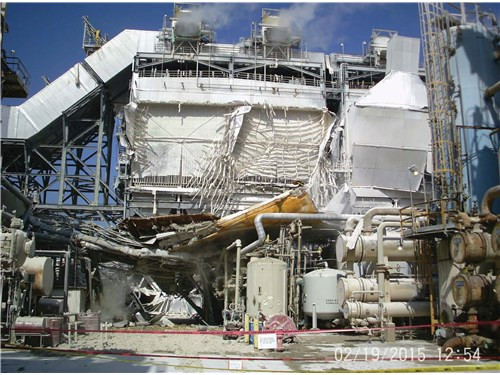
GREENWIRE | When an explosion shook an oil refinery in the Southern California city of Torrance in early 2015, two workers were injured, debris went flying and dust settled as far as a mile away.
But the outcome could have been horrifically worse, federal investigators with the Chemical Safety and Hazard Investigation Board later concluded. One of the debris fragments landed near a tank containing tens of thousands of pounds of modified hydrofluoric acid, a pollutant that can be deadly at low concentrations. Had the tank been hit and ruptured, the result would have been a “potentially catastrophic” release into the neighborhoods surrounding the plant, the inquiry found.
The refinery, now owned by PBF Energy, is one of about 45 around that country that use hydrofluoric acid — also known as hydrogen fluoride and abbreviated HF — in making high-octane gasoline. Now the possible perils have emerged as a major fault line in the jockeying over the final shape of an EPA plan to tighten “accidental release” regulations on refineries and myriad other industrial operations around the United States that use or store dangerous chemicals.
The White House office is winding up a review of the final version of the rule. EPA plans to publish it early this year, agency spokesperson Remmington Belford said in a recent email.
The draft rule released in 2022 would require refineries reliant on hydrofluoric acid to analyze whether “safer technologies and alternatives” exist.
In the view of industry critics, mishaps of all types remain distressingly common. “These things happen to us here on a very regular basis and by some of the same facilities over and over again,” said Jennifer Hadayia, executive director of Air Alliance Houston, an environmental group, in an interview.
But while some community advocates want EPA to further toughen the final version, the analysis requirement alone has already fueled industry objections.
“The proposal is unwarranted, prohibitively expensive, and will not improve safety,” the American Fuel and Petrochemical Manufacturers, a refiners trade group, told EPA and the White House regulations office in October, according to a slide presentation posted on a government website.
The rule, dubbed “Safer Communities by Chemical Accident Prevention,” would cover almost 12,000 operations — also including facilities as diverse as wastewater treatment plants and farm supply distributorships — that must file risk management plans spelling out how they strive to prevent accidental releases and deal with them once they occur.
Among a raft of other provisions in the 2022 draft, plant operators would have to share chemical hazard information with people living within 6 miles of their facilities and account for the effects of climate change in assessing the odds of an accident.
If those provisions have also spurred opposition, the polemics over the planned refinery requirement have been especially heated, with the ever-sensitive topic of gasoline pump prices lurking in the background.
Hydrofluoric acid is among almost 190 contaminants deemed hazardous under the Clean Air Act. It can easily penetrate the skin and then damage cells, with effects that include swelling and fluid buildup in the lungs, according to the Centers for Disease Control and Prevention. Levels as low as 30 parts per million are “lethal,” EPA said in the proposed rule.
But many refineries employ hydrofluoric acid to make alkylate, a chemical blend that’s part of the recipe for high-octane gasoline, often billed as improving car engine performance. Of 129 refineries, about one-third depend on the compound, according to the American Fuel and Petrochemical Manufacturers, which says that it has been safely used since World War II, with few releases and no “off-site fatalities.”
EPA “is attempting to put up a barrier to HF alkylation, and by extension U.S. fuel production,” Geoff Moody, the group’s senior vice president of government relations, said in a statement, adding that there would be “devastating consequences” for “affordable domestic energy” if a significant amount of production capacity is lost. While some refineries instead use sulfuric acid, conversion can cost up to $800 million per unit, according to the group.
EPA’s view is more nuanced, with findings that the price tag would range from $35 million to $900 million, based on a particular refinery’s production levels. The practicality “of these potentially safer alternatives is situation-specific,” with owners and operators “usually in the best position to make these determinations,” the agency said in the draft rule.
It’s not the only front on which EPA is stepping up pressure on refiners that use hydrofluoric acid. In an updated roster of national priorities last summer, the agency’s enforcement staff signaled plans to more closely monitor those plants. Recent releases and concerns about the “potentially catastrophic consequences” support “a focus on these facilities using these hazardous chemicals in their processes,” according to the roster.
But worries about the compound’s role in gasoline production are not new.
“The potential impact of a large-scale HF release in a heavily populated area is so great that it may be impossible for any refiner or community to be fully prepared,” the United Steelworkers union reported in 2013.
“The science clearly says this stuff has got to go,” Steve Goldsmith, president of the Torrance Refinery Action Alliance, formed after the 2015 accident, said in an interview.
The alliance is among more than a dozen organizations that have met with EPA and White House officials while the final rule has been under review.
On top of the safer alternatives analysis proposed by EPA, Goldsmith urged the agency to require individual refineries to convert within three years if that analysis in fact shows there are less dangerous options, according to a script of his remarks he provided to E&E News.
About 20 mostly Democratic attorneys general from New York, Iowa and other states are urging EPA to require a “more comprehensive and robust evaluation of alternatives to hydrofluoric acid alkylation.”
Triggering the February 2015 blast at the Torrance refinery was a buildup of hydrocarbons in a pollution control device, the Chemical Safety Board found.
One of the resulting pieces of debris hit scaffolding in the plant’s alkylation unit, narrowly missing the tank laden with modified hydrofluoric acid, according to the probe.
More than 300,000 people live within 3 miles of the plant; had the tank ruptured, many residents could have died or been seriously injured by a low-lying cloud of the pollutant, the board said in a news release.
At the time of the explosion, the Torrance plant was owned by Exxon Mobil, which sold it to New Jersey-based PBF the next year. A PBF spokesperson did not reply to a phone message or query submitted through an online contact page. But the refinery’s website features an industry consultant’s warning that an HF ban won’t reduce risk but “will threaten fuel supplies.”
EPA’s 2022 proposal marked the latest round in a politicized struggle that now spans three presidential administrations.
In 2017, EPA under outgoing President Barack Obama tightened accidental release regulations after an explosion four years earlier at a West, Texas, fertilizer storage and distribution facility killed 15 people and leveled much of the surrounding area.
But in 2019, with the backing of industry groups and Republican state officeholders, the Trump administration largely scrapped those stricter standards on the grounds that they were costly and unneeded.
Air Alliance Houston and a dozen other groups in 2020 challenged the rollback in court. Proceedings in the litigation have since been on hold as EPA reconstructs and — in some ways — expands on the Obama-era blueprint.
The White House regulations office, Hadayia said, “needs to stop dragging its feet because we can’t wait anymore in Houston for an improved rule.”
 Torrance Refinery Action Alliance