Join TRAA and other Organizations on April 5th

Subscribe to continue reading

Subscribe to get access to the rest of this post and other subscriber-only content.

PBF Energy to restart California refinery in stages

From Investing.com: PBF Energy Inc. announced plans to resume operations at its Martinez, California refinery, which was shut down after a fire on February 1, 2025. The refinery, with a capacity of 157,000 barrels per day, will restart in two phases, with some units including the crude unit expected to begin operations early in the second quarter of 2025. The remaining units should be operational by the fourth quarter of 2025.

PBF Energy, which owns and operated the Torrance Refinery, also has safety issues at its plant in northern California. At least that one doesn’t use HF in its alkylation process. The article gives some financial information about the company and its prospects.

Multiple Reports from TRAA’s very successful 10th Anniversary Remembrance

News reports are now coming in about our 10th Anniversary of the Explosion Event last weekend, and they highlight the amazing amount of work that TRAA had done during that time. Both articles here discuss the bill by Rep. Maxine Waters (HR 10441) and the petition by the NRDC, CBE and CAC to the EPA to demand that the HF be removed from refineries nationwide.

From the South Bay Daily Breeze: 10 years after Torrance Refinery explosion, pressure for a ban on MHF builds

Explosion

As the South Bay community marks the 10th anniversary of an explosion at Torrance Refinery, advocates and elected officials are renewing their efforts to ban modified hydrofluoric acid at the facility — including via federal legislation.

Also reporting on our event last weekend, LegalPlanet asks Why Isn’t Hydrofluoric Acid Banned at Oil Refineries? In it, author Brennon Mendez reports This past Saturday, Congresswoman Maxine Waters announced that she would re-introduce and seek additional co-sponsors for her 2024 bill, HR 10441, banning the use of hydrofluoric acid (HF) at new oil refineries and requiring existing refineries to stop using HF within 5 years of the bill’s passage. Rep. Waters (CA-43) made that announcement to an adoring crowd of environmental justice advocates from the South Bay, gathered by the Torrance Refinery Action Alliance to commemorate the tenth anniversary of the February 2015 explosion that nearly released tons of deadly HF into neighboring communities, which would’ve caused mass casualties.

Also see this report from KTLA 5 News about our event.

TRAA Press Release of 10th Anniversary of Explosion

TRAA has released the following Press Release in conjunction with the 10th Anniversary Event today.

NRDC Files Petition to EPA to Prohibit HF in US Refineries


The Natural Resources Defense Council (NRDC) submitted a legal petition to the U.S. Environmental Protection Agency (EPA) on February 11, 2025, under the Toxic Substances Control Act. See Link for details. It includes links to download the full petition and its appendices.

This petition sets out the facts establishing why the EPA must establish regulations to prohibit the use of HF in domestic oil refining to eliminate the unreasonable risks that this use presents to public health and the environment. They filed the petition with their partners: Clean Air Council and Communities for a Better Environment (CBE), groups dedicated to protecting people from pollution in the Mid-Atlantic and California, respectively.  

We expect at least one representative from CBE to attend our Saturday Event, and talk more about this.

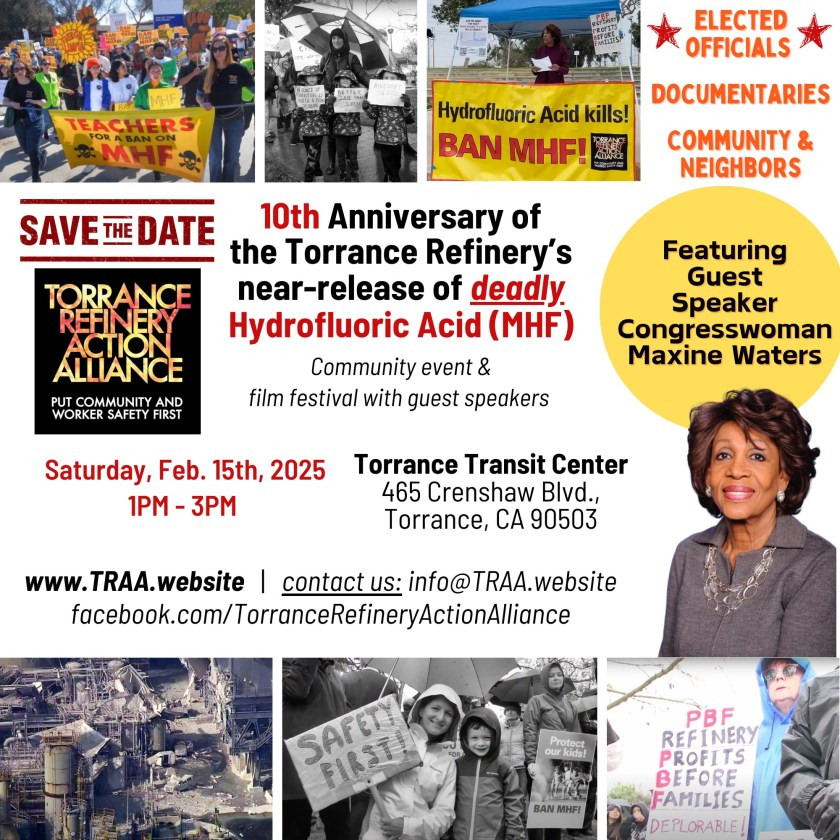
TRAA Event to Commemorate the 10th Anniversary of the Torrance Refinery Explosion


In remembrance to the close call we had with the near-release of deadly HF in the explosion, TRAA is holding a film festival, along with guest speakers on Saturday, Feb 15th 1:00pm – 3:00 at the Torrance Transit Center. All are welcome to come and learn more about the threat.

In that explosion, a 4-ton piece of equipment was blown off a structure and landed about 100 feet away, next to a tank containing massive amounts of deadly HF.

Had it traveled 6 feet farther it could have ruptured the tank or pipes leading into it, with deadly consequences for the entire neighborhood. We MUST do what we can to prevent such a catastrophe in the future!

How Safe is the Torrance Refinery?

As we come upon the 10th anniversary of the Torrance Refinery explosion, look at how they have changed. On January 6th, the AQMD reported an Unplanned Flare event at the Torrance Refinery, the first of the new year.

While planned events are used for scheduled maintenance, the Unplanned Event is “Used for emergencies caused by equipment failure, power outage, or other unanticipated event which requires the refinery to dispose of the gases in order to prevent harm to workers, the community, or to the environment.” per the AQMD.

Last year there were a total of 20 Unplanned Events, compared to 7 Planned events, even worse than 2023’s 13 Unplanned Events. This raises the question about the safety of the refinery. We wonder if Torrance Refinery’s maintenance and controls are sufficient to keep the neighborhood safe, especially when they insist on using such a hazardous chemical as HF.

40 years of Bhopal gas tragedy

From firstpost.com: Forty years ago, on the intervening night of December 2-3, a terrible tragedy struck Bhopal as highly toxic methyl isocyanate (MIC) leaked from American company Union Carbide’s pesticide factory in the city. The disaster killed several thousands and exposed five lakh people to the poisonous gas. Its impact is still being felt by second and third generations of the survivors

Although it was a different chemical, the disaster shows what a hazardous chemical can do when handled in large quantities, especially in a highly populated area. It should serve as a warning to us all.

Phillips 66 closing its LA Harbor-area refinery

Per the Daily Breeze, Oct.16 2024: Phillips 66 announced Wednesday it will close its Los Angeles-area refinery next year, idling 600 employees and 300 contractors who work at two sprawling facilities that straddle Wilmington and Carson in the port region.

(Photo by Brittany Murray, Press-Telegram/SCNG)

A statement cited uncertainty about the “sustainability” of the facility going forward.

“We understand this decision has an impact on our employees, contractors and the broader community,” Mark Lashier, chairman and CEO of Phillips 66, said in a statement. “We will work to help and support them through this transition.”

The refinery includes a crude-oil processing facility that operates on 235 acres in Carson and a separate 424-acre facility in Wilmington where the processed oil is finalized into “finished products.”

2 dead, 35 injured after chemical leak of hydrogen sulfide at Texas oil refinery

From USA Today, Oct 11, 2024 At least two people are dead, and nearly three dozen others suffered injuries after a chemical leak at an oil refinery Thursday, prompting a shelter-in-place order for two East Texas cities, officials said.

The leak took place at Pemex Deer Park, about 18 miles east of Houston, the Harris County Sheriff’s Office said.

Also the local news station reported: Following a release of chemicals at the PEMEX facility in Deer Park, several surrounding residents sought medical treatment, according to Houston attorney Ryan Zehl.

“They started experiencing headaches, nausea, irritation, shortness of breath, symptoms typically associated with hydrogen sulfide poisoning,” Zehl said. “And so, they went to go get medical treatment and it turned out they were diagnosed with hydrogen sulfide poisoning.”

Zehl said he is representing six people form the surrounding neighborhood and he is also speaking with contractors working in the facility at the time of the release.

“What we know so far is that a valve opened that shouldn’t have opened and released hydrogen sulfide,” Zehl said.

This last statement shows the peril of storing massive amounts of deadly hazardous materials. In addition to natural disasters, accidents and sabotage threats, a simple mistake can kill. And HF is far more deadly than the hydrogen sulfide in this event.