The US Environmental Protection Agency (EPA) today announced the release of a final revision to the Risk Management Plan (RMP) rule governing 11,740 facilities using dangerous chemicals, including 40+ oil refineries that use hydrofluoric acid (HF), a deadly chemical capable of causing thousands of deaths in a few minutes. (see attached “Summary Info Sheet”) (link)
The new RMP rule includes many positive improvements and states its goal is “to protect the health and safety of all communities by requiring industry to prevent accidental releases of dangerous chemicals that could otherwise cause deaths and injuries, damage property and the environment, or require surrounding communities to evacuate or shelter-in-place”. EPA 3/1/24. For some positive developments see the statement from Environmental Justice & Health Alliance (link).
However, the Rule fails to protect vulnerable Environmental Justice burdened communities living near HF refineries in 20 states. The EPA recognized that HF units are vulnerable to accidents, natural disasters, and terrorist acts. However, the new rule does not meet the standard set by California Attorney General Rob Bonta and 20 other State AGs in their 2022 letter to the EPA which quoted the US Chemical Safety Board saying that it is “fully within the authority and responsibility of the EPA pursuant to …the [Chemical Disaster Rule] Risk Management Plan (RMP) Rule (40 CFR Part 68.67) as well as through its General Duty Clause.” … “toimpose a robust safer technology protocol that will drive the remaining hydrofluoric acid-using refineries to identify and implement safer alternatives”
The new rule makes significant improvements over the Trump era version by restoring the requirement that HF refineries do an analysis of safer alternatives. It adds for the first time requirements to analyze the “practicality” of these alternatives, requiring HF refineries to state why they are not using safer chemicals. This provides the EPA a tool to “influence” HF refineries toward implementation of conversion. Many of the improvements over the draft rule stem from grass roots advocacy. For example, the United SteelWorkers scored victories in the significant expansion of worker participation in safety processes.
Many of the HF dangers highlighted by TRAA, as well as those alerted to by national security experts, are referenced in the EPA release. Nonetheless, TRAA sees this rule as a three-legged stool without its 3rd leg. Without requiremening conversion to a safer alternative, the rule does little to protect the community from a catastrophic, and potentially deadly, release of HF.
There are significant improvements in response to community demands but for the 14 million people living around HF refineries and the nearly 1,000,000 in Los Angeles County alone, this effort by the Biden administration to improve on the terrible record of the Trump administration is shockingly inadequate. Especially, when it is well known that President Biden and his family live within the circle of risk for the Trainer, Pennsylvania HF refinery. TRAA will not stop calling for exceptional action at the local, state or federal level to remove this exceptional danger of mass casualties.
On Friday, March 1st, the US Environmental Protection Agency (EPA) issued long-awaited regulations to strengthen the Risk Management Program (RMP). The RMP requires roughly 12,000 industrial facilities that use or store extremely hazardous substances to develop Risk Management Plans that identify prevention and response measures for chemical releases.
The new rule restores critical disaster planning and prevention protections under the program after it was gutted in 2019 under the Trump administration.
According to the Union of Concerned Scientists, “The RMP was first established in 1996 and in the nearly 30 years since, the program has been subject to political tug-of-war. After the Biden-Harris administration took office, the EPA held a series of listening sessions, and in 2022, proposed the “Safer Communities by Chemical Accident Prevention” rule. The Union of Concerned Scientists (UCS) joined hundreds of organizations and individuals in commenting on the proposed rules and testifying at EPA’s public hearings. While the proposal restored many of the rollbacks under the Trump administration, it still left some to be desired in terms of preventing chemical disasters.“
While it doesn’t go as far as w TRAA would wish, it is a large improvement. For instance, according to the UCS
One of the most notable actions under this rule is that EPA finally created a public database with information about RMP facilities. For years, information about facilities was only accessible through Freedom of Information Act (FOIA) requests, which can be tedious and take a long time to fulfill, or by visiting EPA reading rooms in person. For years, the agency claimed that information about facilities could not be made public due to national security concerns. This was a major disservice to communities around these facilities, as well as to first responders, after an incident occurred. While EPA could have made these data available at any time, we are grateful that the agency is doing so now.
The online tool allows users to search by facility and company name, ID and NAICS code, location, and the chemicals and processes used there. Users can also access the facility’s most recent risk management plan online.
TRAA held a successful rally and march on Saturday, thanks to the many efforts of Isabel Douvan Schwartz, Zach Badaouie, Steve Goldsmith and numerous others.
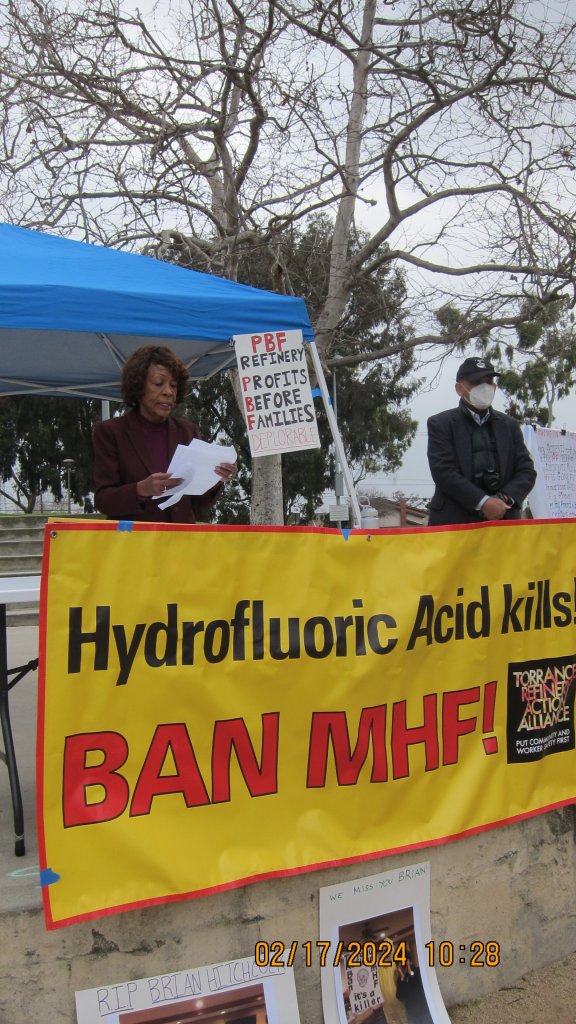
Headline speaker Rep. Maxine Waters gave a rousing speech, as did local activists and politicians. Breaking news: Rep Waters announced that she will raise a bill in the House to force a conversion from HF. After music and speeches, the crowd marched from Columbia Park to the refinery entrance to show them we are still serious in our demand that the PBF Refinery convert from HF/MHF to one of the several “commercially proven, vastly safer alternatives.
A Los Angeles Times article proclaimed “Torrance residents fear continued use of hydrofluoric acid at Torrance Refinery endangers community“, and gave a very positive review of the rally. It also included a PBF statement “We are aware of the misleading and inaccurate claims by the activist group, which they have been making for years,” . TRAA uses only information provide by the oil industry, government agencies or highly vetted experts. We would welcome a dialogue with PBF for them to identify the “misleading statements” so we can clarify or correct any errors. We also want to learn the contents of their report on alternative chemicals that was required by October 2022 and has been hidden by them and the Torrance Fire Department.
In a response to the LA Times article, we wrote the following letter to the editor:
Thanks for your February 17th article on Torrance Refinery Action Alliance’s community demonstration for conversion from deadly chemical HF/MHF used at only two refineries in California — both in LA County — to a vastly safer, commercially-proven alternative. Congressmember Maxine Waters broke the news that she would introduce legislation echoing the words of AG Rob Bonta “to drive the remaining hydrofluoric acid-using refineries to identify and implement safer alternatives”
Torrance Refinery owner PBF, dismissed TRAA as “activists making mis-leading statements.” Statements found on http://www.TRAA.website are from industry, government, or highly-vetted expert sources. We challenge PBF to give specifics on these “misleading statements”, so we can clarify or correct. We advocate for transparency and accountability so why are they hiding the reports required by state regulation on proven safer alternatives.
US Chemical Safety Board states that a large HF release nearly occurred in Torrance in 2015 possibly killing thousands. They urge converting to a vastly safer commercially proven alternative. To us these are not misleading statements, they’re chilling!
Steven Goldsmith, President, Torrance Refinery Action Alliance
Candidates questioned about HF at Candidate Forums
At all 4 recent Torrance City Council candidate forums questions were asked about the candidates’ views on HF, showing that this issue is still very prominent in the community. Over 500 handouts were distributed about the upcoming February 17th event at Columbia park. Many attendees were aware of the issue and supportive of conversion to a safer alternative chemical.
Join us – Rally this Saturday
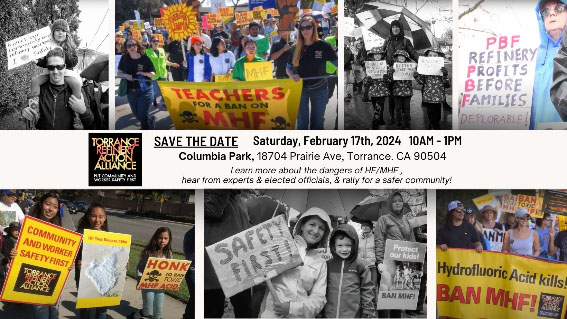
Join us on Saturday, February 17th from 10am until 1pm@ Columbia Park, Prairie Ave. (north of 190th St.) in Torrance, CA
Learn more about the dangers of Hydrofluoric Acid (HF/MHF) used at the Torrance & Wilmington refineries, hear from experts & elected officials, and rally for the safer community we all deserve! Join us in telling Valero Energy Corporation (based in Texas) & PBF Energy, Inc. (based in New Jersey) that communities deserve safer places to live, learn, and work!
While these private companies rake in hundreds of millions of dollars off of the South Bay, their investment into safer chemicals and safe practices remains lacking. Let’s make sure these two oil refining companies are protecting the safety of all children at nearby schools, of elderly people out for a walk, of our pets and wildlife, and for all! TRAA says, “OUR LIVES ARE WORTH THE COST TO CONVERT!”
For more information about the dangers of HF/MHF, a list of commercially-available alternatives to the deadly chemical, and the status of the fight for safer communities/working conditions, visit us at www.traa.website & join our Facebook page at www.facebook.com/TorranceRefineryActionAlliance
Local teen Summer Spencer created a film about how to shelter in place in case of an HF release at the Torrance Refinery. The film won her the “Girl Scout achiEver of the Gold Award” , and deserves to be seen. It highlights the dangers of HF and some of the history of local efforts to remove this hazard.
Join us on Saturday, February 17th from 10am until 1pm@ Columbia Park, Prairie Ave. (north of 190th St.) in Torrance, CA
Learn more about the dangers of Hydrofluoric Acid (HF/MHF) used at the Torrance & Wilmington refineries, hear from experts & elected officials, and rally for the safer community we all deserve! Join us in telling Valero Energy Corporation (based in Texas) & PBF Energy, Inc. (based in New Jersey) that communities deserve safer places to live, learn, and work!
While these private companies rake in hundreds of millions of dollars off of the South Bay, their investment into safer chemicals and safe practices remains lacking. Let’s make sure these two oil refining companies are protecting the safety of all children at nearby schools, of elderly people out for a walk, of our pets and wildlife, and for all! TRAA says, “OUR LIVES ARE WORTH THE COST TO CONVERT!”
For more information about the dangers of HF/MHF, a list of commercially-available alternatives to the deadly chemical, and the status of the fight for safer communities/working conditions, visit us at www.traa.website & join our Facebook page at www.facebook.com/TorranceRefineryActionAlliance
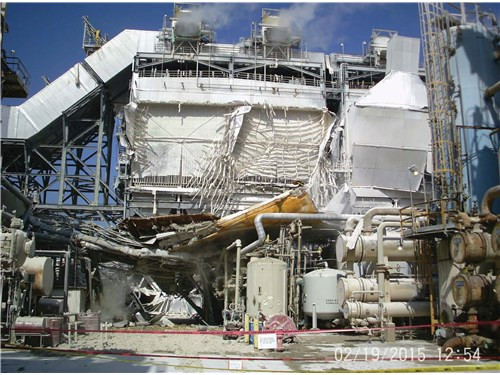
9 years ago, the Torrance Refinery narrowly missed a mass release of toxic HF/MHF. If the 40-ton piece of equipment had landed mere feet closer, the tank of Hydrofluoric Acid (aka HF/MHF) would have been damaged, leading to a potentially catastrophic, mass casualty event. People within a 5.3 mile radius of the refinery would have been put at risk for possible death or serious, irreversible damage to their health from the resulting deadly, ground-hugging gas cloud.
For years, people have rallied across the country for the refineries that use HF/MHF to convert to any of the safer, commercially-proven & available alternatives. Elected officials have attempted to pass legislation to require safer chemical usage at refineries. Government agencies have struggled to enforce safety measures.
WE NEED YOUR HELP MORE THAN EVER!
Join the fight for a safer community to live and work!
The South Coast Air Quality Management District (SCAQMD) recently issued a notice about more unplanned flaring events at the Torrance Refinery, containing the following SCAQMD Link. That is already FIVE UNPLANNED events just this year!
According to the website, an Unplanned Event is used for emergencies caused by equipment failure, power outage, or other unanticipated event which requires the refinery to dispose of the gases in order to prevent harm to workers, the community, or to the environment.
So they have had 5 emergencies in the first 9 days of the year, compared to 13 during last year. The AQMD notice contained a link to a list of all the flaring events at the Torrance Refinery (Scroll down to Past Flare Events and click in the Event ID box to display newest first). It shows events for the last several years, which total by year:
2024
2023
2022
2021
Planned
1
7
12
7
Unplanned
5
13
24
5
And we are only 10 days into the year! Is anyone looking into this potential disaster? Does anyone care?
Join us on Saturday, February 17th from 10am until 11:30 am@ Columbia Park, Prairie Ave. (north of 190th St.) in Torrance, CAfor TRAA’s 9th anniversary of a near-release of deadly HF!
Join us on Saturday, February 17th from 10am until 1pm@ Columbia Park, Prairie Ave. (north of 190th St.) in Torrance, CA
Learn more about the dangers of Hydrofluoric Acid (HF/MHF) used at the Torrance & Wilmington refineries, hear from experts & elected officials, and rally for the safer community we all deserve! Join us in telling Valero Energy Corporation (based in Texas) & PBF Energy, Inc. (based in New Jersey) that communities deserve safer places to live, learn, and work!
While these private companies rake in hundreds of millions of dollars off of the South Bay, their investment into safer chemicals and safe practices remains lacking. Let’s make sure these two oil refining companies are protecting the safety of all children at nearby schools, of elderly people out for a walk, of our pets and wildlife, and for all! TRAA says, “OUR LIVES ARE WORTH THE COST TO CONVERT!”
For more information about the dangers of HF/MHF, a list of commercially-available alternatives to the deadly chemical, and the status of the fight for safer communities/working conditions, visit us at www.traa.website & join our Facebook page at www.facebook.com/TorranceRefineryActionAlliance
9 years ago, the Torrance Refinery narrowly missed a mass release of toxic HF/MHF. If the 40-ton piece of equipment had landed mere feet closer, the tank of Hydrofluoric Acid (aka HF/MHF) would have been damaged, leading to a potentially catastrophic, mass casualty event. People within a 5.3 mile radius of the refinery would have been put at risk for possible death or serious, irreversible damage to their health from the resulting deadly, ground-hugging gas cloud.
For years, people have rallied across the country for the refineries that use HF/MHF to convert to any of the safer, commercially-proven & available alternatives. Elected officials have attempted to pass legislation to require safer chemical usage at refineries. Government agencies have struggled to enforce safety measures.
WE NEED YOUR HELP MORE THAN EVER!
Join the fight for a safer community to live and work!
Refineries that use hydrofluoric acid in making high-octane gasoline are at the center of a high-stakes fight over costs, safety and federal regulations designed to prevent chemical disasters.
By: Sean Reilly Reporter E&E News/POLITICO Ph: 202-316-4596 Twitter:@SeanatGreenwire
GREENWIRE | When an explosion shook an oil refinery in the Southern California city of Torrance in early 2015, two workers were injured, debris went flying and dust settled as far as a mile away.
But the outcome could have been horrifically worse, federal investigators with the Chemical Safety and Hazard Investigation Board later concluded. One of the debris fragments landed near a tank containing tens of thousands of pounds of modified hydrofluoric acid, a pollutant that can be deadly at low concentrations. Had the tank been hit and ruptured, the result would have been a “potentially catastrophic” release into the neighborhoods surrounding the plant, the inquiry found.
The refinery, now owned by PBF Energy, is one of about 45 around that country that use hydrofluoric acid — also known as hydrogen fluoride and abbreviated HF — in making high-octane gasoline. Now the possible perils have emerged as a major fault line in the jockeying over the final shape of an EPA plan to tighten “accidental release” regulations on refineries and myriad other industrial operations around the United States that use or store dangerous chemicals.
The White House office is winding up a review of the final version of the rule. EPA plans to publish it early this year, agency spokesperson Remmington Belford said in a recent email.
The draft rule released in 2022 would require refineries reliant on hydrofluoric acid to analyze whether “safer technologies and alternatives” exist.
In the view of industry critics, mishaps of all types remain distressingly common. “These things happen to us here on a very regular basis and by some of the same facilities over and over again,” said Jennifer Hadayia, executive director of Air Alliance Houston, an environmental group, in an interview.
But while some community advocates want EPA to further toughen the final version, the analysis requirement alone has already fueled industry objections.
“The proposal is unwarranted, prohibitively expensive, and will not improve safety,” the American Fuel and Petrochemical Manufacturers, a refiners trade group, told EPA and the White House regulations office in October, according to a slide presentation posted on a government website.
The rule, dubbed “Safer Communities by Chemical Accident Prevention,” would cover almost 12,000 operations — also including facilities as diverse as wastewater treatment plants and farm supply distributorships — that must file risk management plans spelling out how they strive to prevent accidental releases and deal with them once they occur.
Among a raft of other provisions in the 2022 draft, plant operators would have to share chemical hazard information with people living within 6 miles of their facilities and account for the effects of climate change in assessing the odds of an accident.
If those provisions have also spurred opposition, the polemics over the planned refinery requirement have been especially heated, with the ever-sensitive topic of gasoline pump prices lurking in the background.
Hydrofluoric acid is among almost 190 contaminants deemed hazardous under the Clean Air Act. It can easily penetrate the skin and then damage cells, with effects that include swelling and fluid buildup in the lungs, according to the Centers for Disease Control and Prevention. Levels as low as 30 parts per million are “lethal,” EPA said in the proposed rule.
But many refineries employ hydrofluoric acid to make alkylate, a chemical blend that’s part of the recipe for high-octane gasoline, often billed as improving car engine performance. Of 129 refineries, about one-third depend on the compound, according to the American Fuel and Petrochemical Manufacturers, which says that it has been safely used since World War II, with few releases and no “off-site fatalities.”
EPA “is attempting to put up a barrier to HF alkylation, and by extension U.S. fuel production,” Geoff Moody, the group’s senior vice president of government relations, said in a statement, adding that there would be “devastating consequences” for “affordable domestic energy” if a significant amount of production capacity is lost. While some refineries instead use sulfuric acid, conversion can cost up to $800 million per unit, according to the group.
EPA’s view is more nuanced, with findings that the price tag would range from $35 million to $900 million, based on a particular refinery’s production levels. The practicality “of these potentially safer alternatives is situation-specific,” with owners and operators “usually in the best position to make these determinations,” the agency said in the draft rule.
It’s not the only front on which EPA is stepping up pressure on refiners that use hydrofluoric acid. In an updated roster of national priorities last summer, the agency’s enforcement staff signaled plans to more closely monitor those plants. Recent releases and concerns about the “potentially catastrophic consequences” support “a focus on these facilities using these hazardous chemicals in their processes,” according to the roster.
But worries about the compound’s role in gasoline production are not new.
“The potential impact of a large-scale HF release in a heavily populated area is so great that it may be impossible for any refiner or community to be fully prepared,” the United Steelworkers union reported in 2013.
“The science clearly says this stuff has got to go,” Steve Goldsmith, president of the Torrance Refinery Action Alliance, formed after the 2015 accident, said in an interview.
The alliance is among more than a dozen organizations that have met with EPA and White House officials while the final rule has been under review.
On top of the safer alternatives analysis proposed by EPA, Goldsmith urged the agency to require individual refineries to convert within three years if that analysis in fact shows there are less dangerous options, according to a script of his remarks he provided to E&E News.
About 20 mostly Democratic attorneys general from New York, Iowa and other states are urging EPA to require a “more comprehensive and robust evaluation of alternatives to hydrofluoric acid alkylation.”
Triggering the February 2015 blast at the Torrance refinery was a buildup of hydrocarbons in a pollution control device, the Chemical Safety Board found.
One of the resulting pieces of debris hit scaffolding in the plant’s alkylation unit, narrowly missing the tank laden with modified hydrofluoric acid, according to the probe.
More than 300,000 people live within 3 miles of the plant; had the tank ruptured, many residents could have died or been seriously injured by a low-lying cloud of the pollutant, the board said in a news release.
At the time of the explosion, the Torrance plant was owned by Exxon Mobil, which sold it to New Jersey-based PBF the next year. A PBF spokesperson did not reply to a phone message or query submitted through an online contact page. But the refinery’s website features an industry consultant’s warning that an HF ban won’t reduce risk but “will threaten fuel supplies.”
EPA’s 2022 proposal marked the latest round in a politicized struggle that now spans three presidential administrations.
In 2017, EPA under outgoing President Barack Obama tightened accidental release regulations after an explosion four years earlier at a West, Texas, fertilizer storage and distribution facility killed 15 people and leveled much of the surrounding area.
But in 2019, with the backing of industry groups and Republican state officeholders, the Trump administration largely scrapped those stricter standards on the grounds that they were costly and unneeded.
Air Alliance Houston and a dozen other groups in 2020 challenged the rollback in court. Proceedings in the litigation have since been on hold as EPA reconstructs and — in some ways — expands on the Obama-era blueprint.
The White House regulations office, Hadayia said, “needs to stop dragging its feet because we can’t wait anymore in Houston for an improved rule.”
On Tuesday, TRAA representatives will make a presentation to the federal Office of Management and Budget (OMB) to advocate for a strong EPA rule governing the use of HF in refineries across the US. Over the last several years numerous experts have publicly called for a conversion away from this most dangerous chemical wherever feasible. For instance Christine Todd Whitman and other national security experts said in their Letter from National Security Experts “For decades, our country has failed to squarely address the dangers of hazardous chemical facilities ― from oil refineries to water treatment plants. An accident, natural disaster, or deliberate attack could trigger an explosion or chemical release that could kill thousands of people. Millions of our citizens live and work near these dangerous facilities.”



 Torrance Refinery Action Alliance