In The News

NRDC Files Petition to EPA to Prohibit HF in US Refineries


The Natural Resources Defense Council (NRDC) submitted a legal petition to the U.S. Environmental Protection Agency (EPA) on February 11, 2025, under the Toxic Substances Control Act. See Link for details. It includes links to download the full petition and its appendices.

This petition sets out the facts establishing why the EPA must establish regulations to prohibit the use of HF in domestic oil refining to eliminate the unreasonable risks that this use presents to public health and the environment. They filed the petition with their partners: Clean Air Council and Communities for a Better Environment (CBE), groups dedicated to protecting people from pollution in the Mid-Atlantic and California, respectively.  

We expect at least one representative from CBE to attend our Saturday Event, and talk more about this.

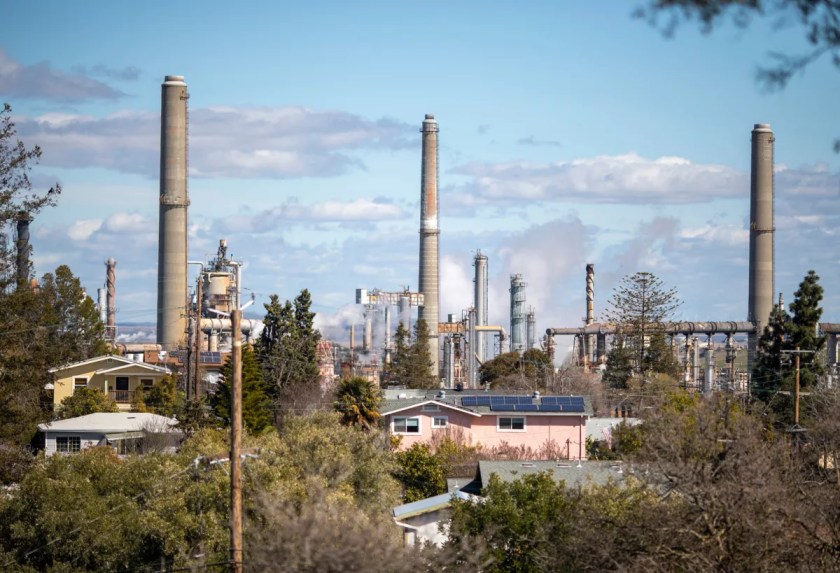
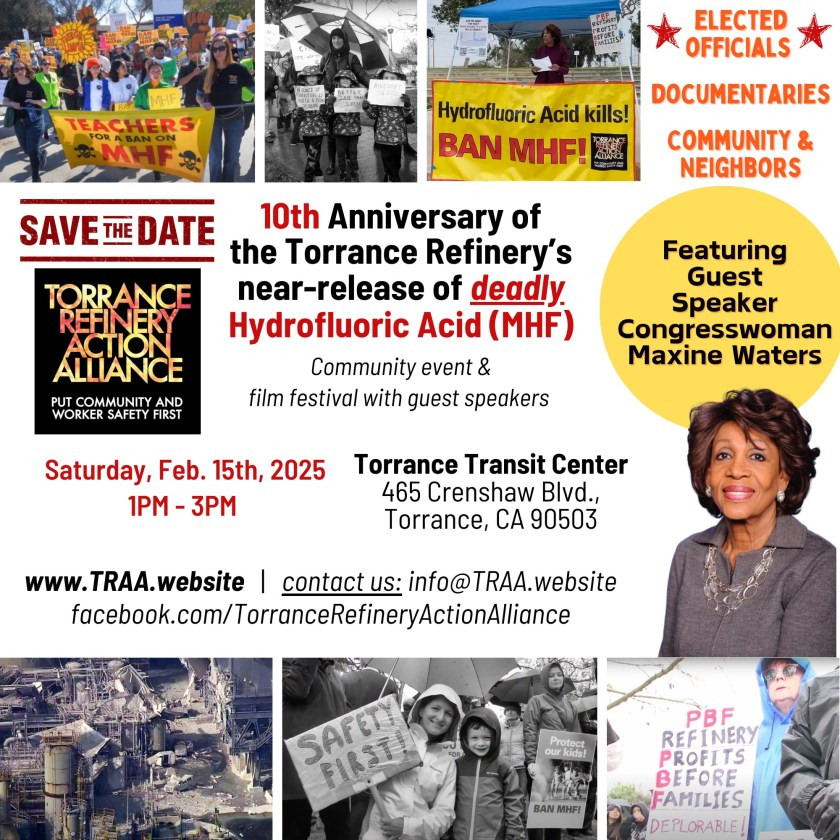
TRAA Event to Commemorate the 10th Anniversary of the Torrance Refinery Explosion


In remembrance to the close call we had with the near-release of deadly HF in the explosion, TRAA is holding a film festival, along with guest speakers on Saturday, Feb 15th 1:00pm – 3:00 at the Torrance Transit Center. All are welcome to come and learn more about the threat.

In that explosion, a 4-ton piece of equipment was blown off a structure and landed about 100 feet away, next to a tank containing massive amounts of deadly HF.

Had it traveled 6 feet farther it could have ruptured the tank or pipes leading into it, with deadly consequences for the entire neighborhood. We MUST do what we can to prevent such a catastrophe in the future!

How Safe is the Torrance Refinery?

As we come upon the 10th anniversary of the Torrance Refinery explosion, look at how they have changed. On January 6th, the AQMD reported an Unplanned Flare event at the Torrance Refinery, the first of the new year.

While planned events are used for scheduled maintenance, the Unplanned Event is “Used for emergencies caused by equipment failure, power outage, or other unanticipated event which requires the refinery to dispose of the gases in order to prevent harm to workers, the community, or to the environment.” per the AQMD.

Last year there were a total of 20 Unplanned Events, compared to 7 Planned events, even worse than 2023’s 13 Unplanned Events. This raises the question about the safety of the refinery. We wonder if Torrance Refinery’s maintenance and controls are sufficient to keep the neighborhood safe, especially when they insist on using such a hazardous chemical as HF.

40 years of Bhopal gas tragedy

From firstpost.com: Forty years ago, on the intervening night of December 2-3, a terrible tragedy struck Bhopal as highly toxic methyl isocyanate (MIC) leaked from American company Union Carbide’s pesticide factory in the city. The disaster killed several thousands and exposed five lakh people to the poisonous gas. Its impact is still being felt by second and third generations of the survivors

Although it was a different chemical, the disaster shows what a hazardous chemical can do when handled in large quantities, especially in a highly populated area. It should serve as a warning to us all.

Phillips 66 closing its LA Harbor-area refinery

Per the Daily Breeze, Oct.16 2024: Phillips 66 announced Wednesday it will close its Los Angeles-area refinery next year, idling 600 employees and 300 contractors who work at two sprawling facilities that straddle Wilmington and Carson in the port region.

(Photo by Brittany Murray, Press-Telegram/SCNG)

A statement cited uncertainty about the “sustainability” of the facility going forward.

“We understand this decision has an impact on our employees, contractors and the broader community,” Mark Lashier, chairman and CEO of Phillips 66, said in a statement. “We will work to help and support them through this transition.”

The refinery includes a crude-oil processing facility that operates on 235 acres in Carson and a separate 424-acre facility in Wilmington where the processed oil is finalized into “finished products.”

2 dead, 35 injured after chemical leak of hydrogen sulfide at Texas oil refinery

From USA Today, Oct 11, 2024 At least two people are dead, and nearly three dozen others suffered injuries after a chemical leak at an oil refinery Thursday, prompting a shelter-in-place order for two East Texas cities, officials said.

The leak took place at Pemex Deer Park, about 18 miles east of Houston, the Harris County Sheriff’s Office said.

Also the local news station reported: Following a release of chemicals at the PEMEX facility in Deer Park, several surrounding residents sought medical treatment, according to Houston attorney Ryan Zehl.

“They started experiencing headaches, nausea, irritation, shortness of breath, symptoms typically associated with hydrogen sulfide poisoning,” Zehl said. “And so, they went to go get medical treatment and it turned out they were diagnosed with hydrogen sulfide poisoning.”

Zehl said he is representing six people form the surrounding neighborhood and he is also speaking with contractors working in the facility at the time of the release.

“What we know so far is that a valve opened that shouldn’t have opened and released hydrogen sulfide,” Zehl said.

This last statement shows the peril of storing massive amounts of deadly hazardous materials. In addition to natural disasters, accidents and sabotage threats, a simple mistake can kill. And HF is far more deadly than the hydrogen sulfide in this event.

US files $4.2-million settlement for fire, explosion at former South Philadelphia refinery

From the Oil & Gas Journal Oct 8, 2024 The US government filed a $4.2 million settlement with Philadelphia Energy Solutions Refining and Marketing LLC (PES) for Clean Air Act penalties related to the June 21, 2019, fire and explosion at its former South Philadelphia refinery.

The fire and explosion at the 335,000 b/d refining complex prompted a temporary shelter-in-place for area residents and injured five refinery workers (OGJ Online, June 21, 2019). PES and its subsidiaries filed for Chapter 11 federal bankruptcy protection a month later (OGJ Online, July 22, 2019).

The Environmental Protection Agency (EPA) said the settlement, filed in US Bankruptcy Court, represents the largest Clean Air Act 112(r) penalty it has ever imposed for a single incident. That section of the CAA requires infrastructure owners and operators to ensure that regulated and other “extremely hazardous substances” are managed safely, EPA said in a press release. 

The agency alleges that PES violated the rule that compels plants to identify and assess the hazards posed by regulated substances, develop an accident-prevention program to reduce the risk of accidental releases, and create an emergency-response program. 

“The company violated these requirements by, among other things, failing to ensure that its refining operations, particularly the hydrofluoric acid unit, were designed, built and operated in accordance with recognized and generally accepted good engineering practices,” EPA notes. The settlement marks EPA’s final settlement with PES, the agency said.

The settlement stems from the 2019 explosion and fire at the Pemex Philadelphia Refinery which included a release of HF. (The HF fortunately caused no injuries itself as it was evidently destroyed in the explosion). (See our report Wake-up Call: Refinery Disaster in Philadelphia from July 2023 for more information about the disaster. It gives details of the sequence of events, and points out that the safeguards to prevent an HF release they had in place DID NOT FUNCTION.)

TRAA Member sends Citizen Petition to EPA regarding Title-V Permit

Dr. Genghmun Eng submitted a Formal Petition to the EPA Administrator at the US EPA National Headquarters (HQ), objecting to the Region 9 US EPA acceptance of the Title-V Permit Renewal from the SCAQMD as-is for the Valero Ultramar HF Refinery in Wilmington. Although the Region 9 Staff accepted the SCAQMD Permit Renewal version, they suggested that Gengh submit a Formal Petition to the US EPA HQ about his concerns. However, he was warned that US EPA Formal Petitions have a lot of additional requirements, as compared to a simple Public Comment.
Gengh completed his Formal Petition to the US EPA HQ within the limited timeframe allowed, citing numerous deficiencies and outright errors in the permit and its processes, as well as requesting specific needed permit additions and modifications, both being required by the Petition process. He showed that many documents submitted by the refinery operator, which were the basis of the SCAQMD and US-EPA acceptance of the Permit Renewal, were either incomplete or deliberately misleading.
In addition, the US EPA Region 9 Staff sent Gengh a formal letter, stating: “Please note that we cannot object to a permit based on concerns about health and safety that are not related to a Clean Air Act {CAA}”. The CAA was passed in 1970, and the US EPA was also created in 1970 to enforce the CAA.
However, the HF-Alkylation systems were only installed at the Torrance Refinery in 1966, at the Valero Ultramar Refinery in 1969. As ‘new technology’ back then, the refinery industry also created models where even a massive HF release was deemed nearly 100% ‘safe’, because their models claimed that the HF would just fall to the ground as ‘rainout’, and be rendered harmless by means unspecified and unknown. This assumption that HF was nearly 100% ‘safe’ is probably why HF risks are not prominent in the CAA. This ‘rainout’ model was the universal industry belief, and the 1987 Koopman ‘Goldfish’ tests in the Nevada desert released 1000 gallons (about 8000 pounds) of pure HF were conducted to prove that this model was correct. So the Koopman test had collection pans all along the HF release path, to collect the ‘rainout’.
Unfortunately, those tests showed ZERO ‘rainout’. Instead, a massive ground-hugging HF cloud formed, which would have been toxic within minutes to humans 2-3 miles away. So HF went from being nearly 100% ‘safe’ by assumption, to being nearly 100% ‘unsafe’ by test.
As a result, Gengh’s Formal Petition claims that the US EPA erred in 1987, by not demanding an HF phaseout back then, when those Koopman test data first became known. His Petition also requests that the US EPA now correct this historical error by requiring an HF/MHF Phase-Out at the Valero Ultramar Wilmington HF Refinery, as part of their Title-V Permit Renewal. We, the Public, will see what happens next in the coming months. Here is the complete Document.

EPA tightened refinery regs. Why did emissions rise?

Article from E&ENews by Politoco

EPA launched a landmark update to oil refinery regulations almost a decade ago that was supposed to deliver big cuts to the industry’s vast stock of hazardous air pollutants. …

But the toughened rules haven’t delivered for everyone, POLITICO’s E&E News has found in an investigation. In the Salt Lake City area, releases from a Big West Oil plant almost quadrupled during the same period, from about 48,000 pounds to 170,000 pounds. At a Torrance, California, refinery owned by PBF Energy, emissions rose some 75 percent, from about 165,000 pounds to almost 293,000 pounds. Around both plants, the proportion of low-income residents and people of color similarly exceeds the respective state and national averages.

CSB Launches Investigation into Another Release of Toxic HF at Honeywell Facility in Louisiana

Washington D.C. June 10, 2024 – Today, the U.S. Chemical Safety and Hazard Investigation Board (CSB) announced that it is deploying a team of chemical incident investigators to investigate a release of highly toxic hydrofluoric acid (HF)  that occurred last Friday, June 7, 2024, at the Honeywell International Fluorine Products facility in Geismar, LA, that seriously injured a worker there

Honeywell reported that a contract maintenance employee was exposed to the HF while performing maintenance activities at the facility. The worker was hospitalized because of the exposure