
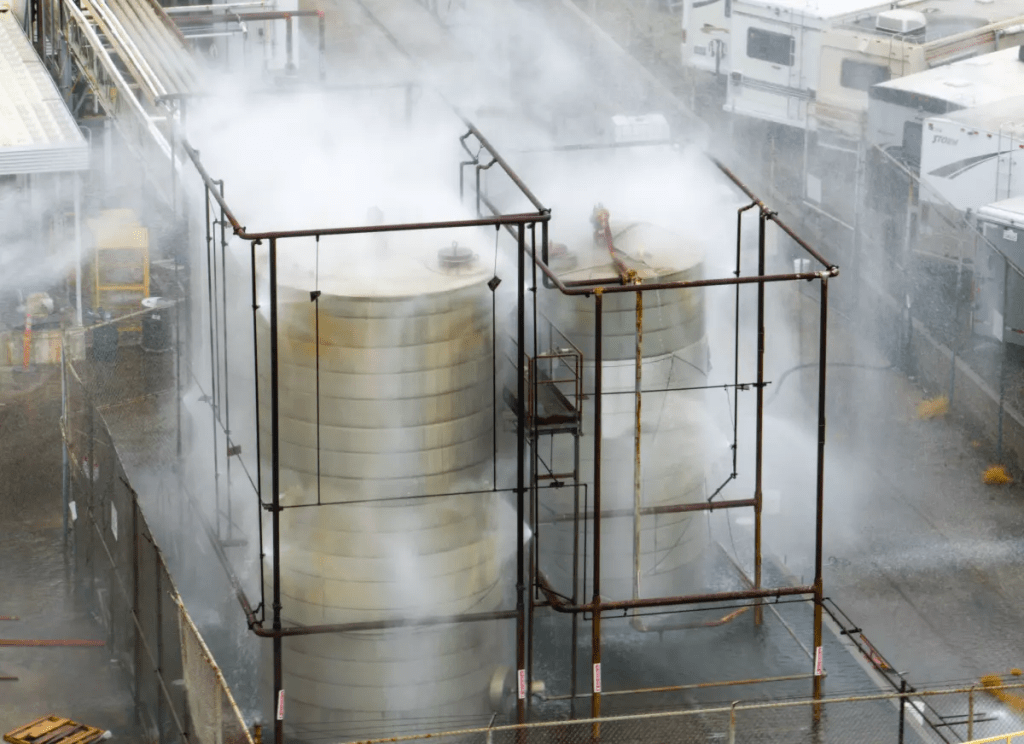
After the ongoing disaster at GKN Aerospace in Garden Grove, we have received numerous questions about the chemical tank, and how the chemical used there (methyl methacrylate – MMA) compares with hydrogen fluoride (HF) used at two local refineries.
While both are extremely dangerous, they have differences which I will try to point out.
Similarities:
Both HF and MMA are normally liquids which can form deadly, flammable, ground-hugging vapor clouds when released
Differences:
MMA is an irritant to the eyes and can cause redness and pain. Irritation of the skin, eye, and nasal cavity has been observed in rodents and rabbits exposed to relatively high concentrations of methyl methacrylate. It is also highly flammable. Per Wikipedia, methyl methacrylate is a mild skin irritant in humans and has the potential to induce skin sensitization in susceptible individuals.
The real danger with MMA is in its storage, where – in this case – chemical reactions caused it to experience an increase in temperature. At one point, the tank began bulging, and it got to a point where it does what is called a BLEVE, which is a ‘boiling liquid expanding vapor explosion. At the high temperatures it would produce the cloud, and not go out as a liquid. While a crack in the vat seems to have relieved the pressure and temperature build-up, it has not solved the problem of what to do if it leaks out in large quantities.
Currently, officials are concerned with the possibility of massive amounts (7000 gallons) of MMA flowing into the rivers and ocean and overwhelming the treatment plants. There is also still the possibility of an explosion, but not as large as earlier feared.
HF is much more toxic if it gets on the skin or is inhaled. It is about 20 times more toxic, but does not tend to get to a thermal expansion. The real issue with HF is a leak or large-scale release, such as nearly happened at Torrance in 2015. A 40-ton piece of equipment was thrown off a structure and landed within just a few feet of a tank containing a vast amount of HF, That rupture would likely have spread rapidly (far too fast for any evacuation) and killed and injured thousands. Its boiling point (where it forms a gas cloud) is just 66 degrees, and it stored at a much higher temperature and pressure in its tanks. Even a rupture of the pipes leading to the tank could produce a disastrous leak.
In short, both chemicals are hazardous and must be handled with extreme care or replaced altogether.

