
On Tuesday, TRAA representatives will make a presentation to the federal Office of Management and Budget (OMB) to advocate for a strong EPA rule governing the use of HF in refineries across the US. Over the last several years numerous experts have publicly called for a conversion away from this most dangerous chemical wherever feasible. For instance Christine Todd Whitman and other national security experts said in their Letter from National Security Experts “For decades, our country has failed to squarely address the dangers of hazardous chemical facilities ― from oil refineries to water treatment plants. An accident, natural disaster, or deliberate attack could trigger an explosion or chemical release that could kill thousands of people. Millions of our citizens live and work near these dangerous facilities.”
Author: traa905
Here We Go Again – Yet Another Unplanned Flaring Event at TRC
The South Coast Air Quality Management District (SCAQMD) recently issued a notice about another unplanned flaring event at the Torrance Refinery, containing the following SCAQMD Link. According to the website, an Unplanned Event is used for emergencies caused by equipment failure, power outage, or other unanticipated event which requires the refinery to dispose of the gases in order to prevent harm to workers, the community, or to the environment
The AQMD notice contained a link to a list of all the flaring events at the Torrance Refinery (Scroll down to Past Flare Events and click in the Event ID box to display newest first). They show that, so far this year, there have been 6 Planned and 12 Unplanned events. That means that there averages more than one emergency every month at this refinery!
With a safety record like this, how can we feel safe living so near, when they use massive quantities of the deadly hydrogen fluoride (HF)? There were 5 small HF releases between 2017 and 2019. The AQMD has not revealed how many HF releases have occur in the last 3 years. Why not?
CSB Applauds New EPA Initiative on Safety at Chemical Facilities that Use Hydrogen Fluoride

Washington D.C. August 31, 2023 – Today, the U.S. Chemical Safety and Hazard Investigation Board (CSB) applauded the updated National Enforcement and Compliance Initiatives (NECIs) recently issued by the U.S. Environmental Protection Agency (EPA) that will continue EPA’s focus on “Reducing Risks of Accidental Releases at Industrial and Chemical Facilities” and, importantly, for the first time emphasize inspecting and addressing noncompliance at facilities that use highly toxic hydrogen fluoride (HF).
While not specifically calling for a conversion to a safer alternative, the CSB does ask for much stronger oversight and controls. (See the full News Release).
At Least 5 Dead in Crash That Led to Toxic Gas Leak
According to CNN from Oct 1st:
At least five people were killed and parts of an Illinois neighborhood were evacuated due to a Friday crash involving a semi-truck carrying thousands of gallons of anhydrous ammonia.
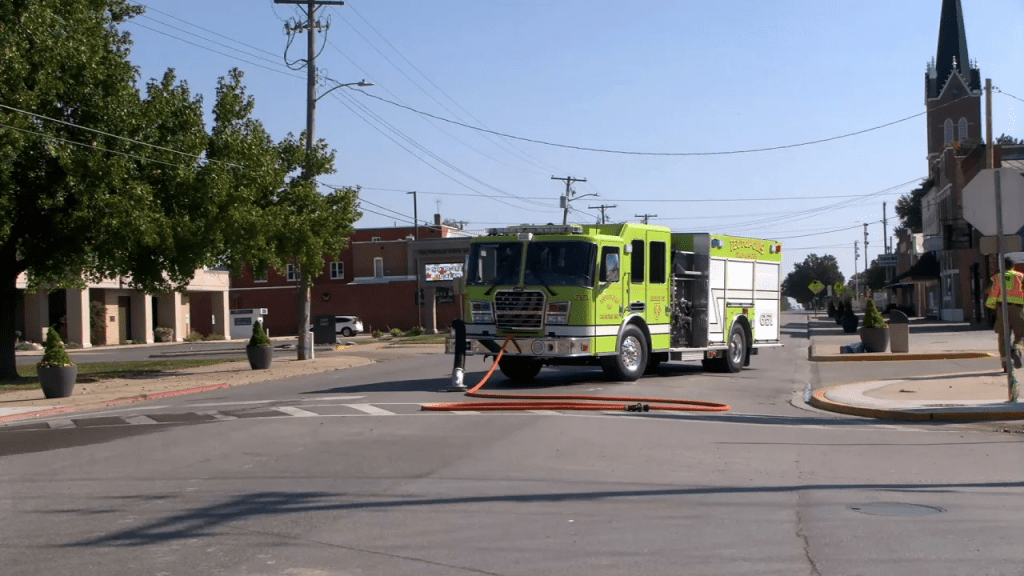
The truck was carrying about 7,500 gallons of the toxic substance at the time of the wreck in Effingham County, according to the Illinois Environmental Protection Agency. The agency said early estimates say more than half of that – about 4,000 gallons – were released.
…
Parts of Teutopolis, a village in south-central Illinois, were evacuated “due to the plume from the ammonia leak” after the crash Friday night on US Highway 40, about a half mile east of Teutopolis, Illinois State Police said..
See full article.
Anhydrous ammonia is the one gas rated as almost as hazardous as HF. But think of the tanker trucks delivering HF to our local refineries. In this area, approximately 12 tanker trucks per mo. each deliver about 36k lb. of modified hydrofluoric acid (MHF) from Louisiana to the Torrance and Valero Wilmington refineries. That is almost 3 quarters of the main holding tank at the refinery!

And if there was a HF release, the resulting vapor cloud could reach many miles in any downwind direction. For example, in 2021 an HF tanker overturned in China, killing one and releasing an unknown amount of HF. Fortunately it was in a rural area.
Tanker trucks are involved in accidents more often than we realize. Overall, in 2017 there were 452 large truck accidents where the cargo was released. Remember, the danger from MHF is just as great outside the refinery as inside. In the volumes it is stored, it should NOT be used if there is ANY alternative. And we know there are numerous viable commercially-available alternatives.
Another Near Miss – Fire & Evacuation at an HF Refinery in Mississippi

Residents in parts of St. John Parish were forced to evacuate their homes Friday morning after a pillar of fire erupted from a storage tank the Marathon Petroleum refinery in Garyville.
In yet another near miss at an HF-using refinery, a fire caused an evacuation order for two miles around the Marathon Refinery in Mississippi. Here are reports from L’Observateur newspaper, and WBRZ.
Officials were responding to what they described as a naphtha release and a fire at one of the refinery’s storage facilities. Naphtha is a flammable liquid hydrocarbon mixture commonly used as a solvent in soaps or varnishes.
St. John Parish President Jaclyn Hotard declared an emergency and ordered the evacuation of a two-mile radius around the fire. That order was lifted around 2:20 p.m. Friday.
Report shows Conversion Costs Less than Claimed
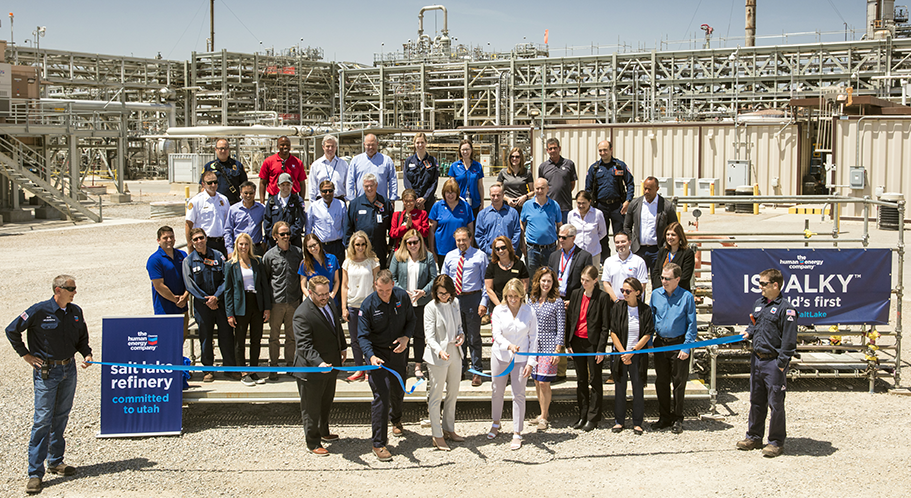
Photo of Chevron workers opening new ISOALKY unit in June 2021.
Did the refineries LIE to us?
TRAA recently learned of this article from 2017, in the Oil & Gas Journal that we somehow missed back then. It indicates a cost of about $67 – $87 million for the retrofit. The Salt Lake City refinery is smaller than many of the other HF refineries, and the final cost was greater than the estimate, but this was the first complete conversion.
The article also shows that PBF and Valero lied to the AQMD when they gave a figure of $900 million. This also indicates that the statement by the American Petroleum Institute to the US EPA in the public comment period on the RMP rule revision was half true – HF Conversion is “commercially proven” (True) but “prohibitively expensive” (False). We have been told that “This Alky unit has been running fine.”
And in the last 6 years, several other alternatives have been available and have proven themselves. And all are much less expensive than the refineries claim. Time to convert?
CSB Video of Husky Superior Refinery Explosion
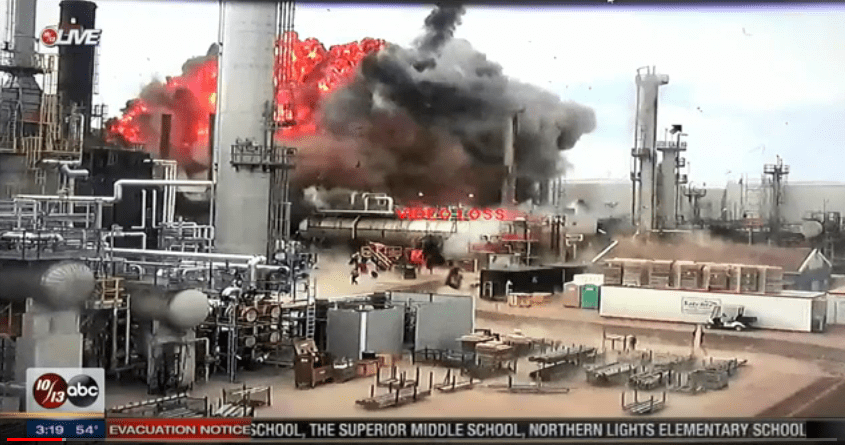
The US Chemical Safety Board (USCSB) recently released a video describing the refinery explosion in Superior WI in which a large HF release nearly happened. This resulted in the evacuation of 25 thousand residents in an area about 24 miles downwind from the refinery. (Think how many people are within that distance of the Torrance Refinery).
Again, the accident occurred because the operators did not take into consideration all the possible scenarios. And we can see the consequences.
Watch the video Here, or visit the CSB Report web page Here.
Wake-up Call: Refinery Disaster in Philadelphia

The US Chemical Safety Board (USCSB) recently released a video describing the refinery explosion in Philadelphia in 2019, primarily showing the hazard that is HF.
Watch the video here.
It gives details of the sequence of events, and points out that the safeguards to prevent an HF release they had in place DID NOT FUNCTION.
The video also names five recommendations to make all the HF-using refineries safer. Note that number 5 is “Inherently Safer Design” – replacing HF with another alkylation process.
We strongly recommend that you view this important video.
What are they trying to hide?
In a little-known regulation established in 2017, refineries that use hydrofluoric acid (HF), an exceptionally dangerous chemical that can cause mass casualties in a few minutes, “are required to conduct a Hierarchy of Hazard Control Analysis (HCA) of its units on a repeating 5-year cycle. A Hazard Control Analysis requires the refinery to enumerate the hazards of each process, and, to assess whether higher order safety measures are feasible” [like using a vastly safer chemical], – a letter from Torrance Refinery-PBF to TRAA, 2018.
In 2018, TRAA met with the Torrance refinery managers. They promised to comply with that regulation and keep in communication. The first 5-year cycle ended October 2022 and somebody has been playing “hide the football” ever since.
First TRAA asked the Governor’s Inter-agency Refinery Task Force on safety to provide the HCA. They said oh! “That’s submitted to the CUPA” (A body of agencies responsible for local emergency preparedness). Torrance Fire Chief Dumais, head of the CUPA, said “You have to File a public document request“. What was he hiding?
Then we were referred to Office of Emergency Services (the Governor again). So we filed a Public Document Request (PDR) with the OES. “Sorry, you should contact the Cal EPA.” Huh?
The LA County Law Library says that if you ask an agency that can get the document, then they’re supposed to provide it. Clearly the Governor’s office has the power to do that. But “hide the football” goes on.
Then TRAA filed a PDR with the CAL EPA and also with the Department of Toxic Substance Control and a person at DTSC told us “Well, the refineries just have to tell the CUPA that they’ve done the analysis but they don’t actually have to give them the document. They keep that.” Huh? Alice in Wonderland meets the Jack of Diamonds!
So then we sent a PDR to Fire Chief Dumais and the Cal EPA online and by certified mail: no document, no email, no call, just SILENCE. 9 months and counting!
Why do resident volunteers have to go through all these hoops to get a report on options to make HF/MHF refineries safer? Shouldn’t that be public?
WHY DOES TRAA WANT THIS DOCUMENT?
Firstly, it might confirm in the refineries own words how dangerous HF/MHF is (Which we all pretty much know) and how the specific details related to the 6 main commercially available safer alternatives could be implemented at these Refineries. We can dream?
One Refinery says their fuel is special and so they can’t use it. Will they actually put that on paper? The other Refinery says that there isn’t enough space. Would this analysis give specifics? The public, regulators and elected officials could learn a lot.
The other big reason we need this document is to show the US EPA. Currently, they are considering revising a rule that could require conversion from HF to a safer alternative. The US EPA has discussed basing their rule on the California model.
TRAA wants to show them how completely inadequate the California model is in getting rid of a chemical (HF/MHF) that can cause mass casualties. The new Rule should include:
- A 3rd party review to see if the alternatives analysis is accurate.
- If there are safer alternatives, conversion would be required.
- HF is used in 41 refineries out of 150 in the US. Refineries are vulnerable to accidents, natural disasters and terrorist attacks and there are 6 major safer alternative processes that are commercially available.
Because the US EPA is close to announcing the final rule we want to show them that the California process will provide little progress towards that goal.
This is why on Tuesday evening June 20th, TRAA is going to Torrance City Council to ask the council to direct the Fire Chief (he is in charge of the County Body responsible for these two reports) to release to the public the Hazardous Chemical Analysis (HCA) for the use of HF at the Torrance and Wilmington refinery.
If you think they should stop hiding this from the public, come to Torrance City Hall at 6pm, June 20th and speak up. If you are coming June 20th, have question or to get regular updates: info@TRAA.website
FBI investigating hazardous fallout from Bay Area refinery
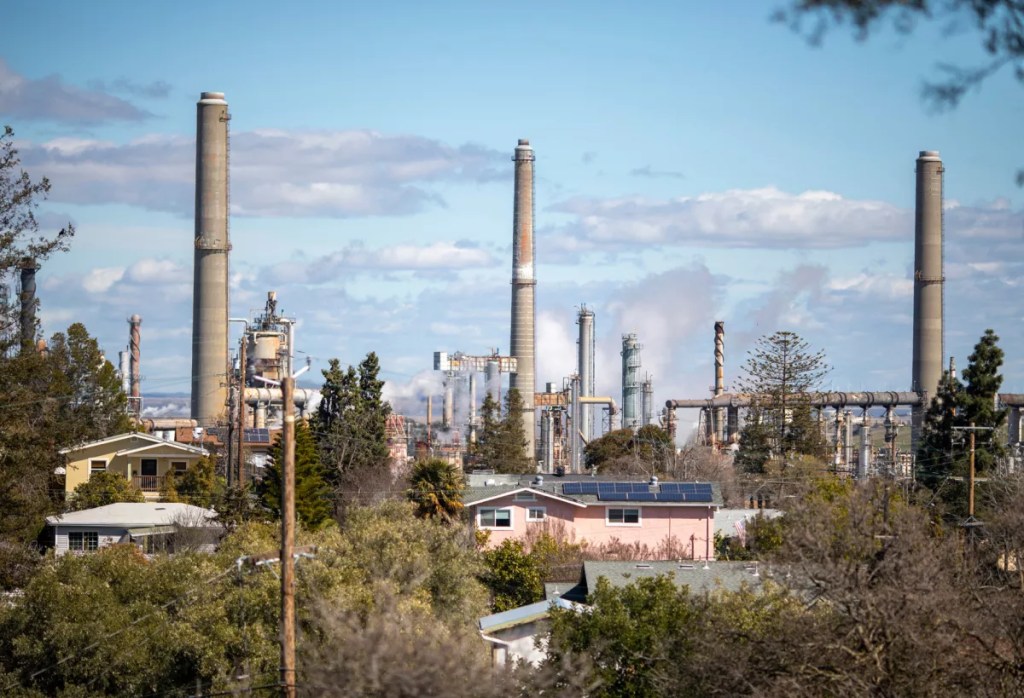
From the Los Angeles Times on May 26th.
The FBI and the U.S. Environmental Protection Agency have opened a joint investigation into the release of hazardous materials from a Bay Area oil refinery — an incident that has sparked heated criticism of the facility’s owner as well as local government officials.
Martinez Refining, located on an 880-acre industrial complex on the northern edge of the city, emitted as much as 24 tons of so-called spent catalyst, a mix of chemicals used to break down crude oil into finished petroleum products like gasoline, according to the local air district.
The fallout left cars, homes and at least one school blanketed in a white powdery substance. Tests determined that the residue contained metals such as aluminum, barium, chromium, nickel, vanadium and zinc. UPDATE on June 9: Bay Area public health authorities announced Thursday that heavy metals released by a refinery in November do not pose a significant risk to gardeners or residents in the city of Martinez, according to new laboratory testing, though testing did find some places with elevated lead and arsenic.
PBF Energy, the parent company of Martinez Refining, also owns the Torrance Refinery, which has had its share of problems also. In the explosion of 2015, we also were covered in a white powdery substance, which they guaranteed posed no risk. Should we be concerned?
 Torrance Refinery Action Alliance