CSB Video of Husky Superior Refinery Explosion

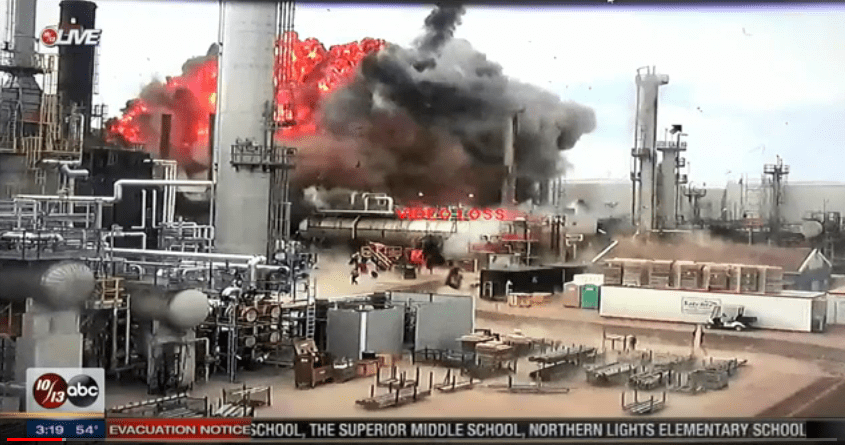
The US Chemical Safety Board (USCSB) recently released a video describing the refinery explosion in Superior WI in which a large HF release nearly happened. This resulted in the evacuation of 25 thousand residents in an area about 24 miles downwind from the refinery. (Think how many people are within that distance of the Torrance Refinery).

Again, the accident occurred because the operators did not take into consideration all the possible scenarios. And we can see the consequences.

Watch the video Here, or visit the CSB Report web page Here.

Wake-up Call: Refinery Disaster in Philadelphia

The US Chemical Safety Board (USCSB) recently released a video describing the refinery explosion in Philadelphia in 2019, primarily showing the hazard that is HF.

Watch the video here.

It gives details of the sequence of events, and points out that the safeguards to prevent an HF release they had in place DID NOT FUNCTION.

The video also names five recommendations to make all the HF-using refineries safer. Note that number 5 is “Inherently Safer Design” – replacing HF with another alkylation process.

We strongly recommend that you view this important video.

What are they trying to hide?

In a little-known regulation established in 2017, refineries that use hydrofluoric acid (HF), an exceptionally dangerous chemical that can cause mass casualties in a few minutes, “are required to conduct a Hierarchy of Hazard Control Analysis (HCA) of its units on a repeating 5-year cycle. A Hazard Control Analysis requires the refinery to enumerate the hazards of each process, and, to assess whether higher order safety measures are feasible” [like using a vastly safer chemical], – a letter from Torrance Refinery-PBF to TRAA, 2018.

In 2018, TRAA met with the Torrance refinery managers. They promised to comply with that regulation and keep in communication. The first 5-year cycle ended October 2022 and somebody has been playing “hide the football” ever since.

First TRAA asked the Governor’s Inter-agency Refinery Task Force on safety to provide the HCA. They said oh! “That’s submitted to the CUPA” (A body of agencies responsible for local emergency preparedness). Torrance Fire Chief Dumais, head of the CUPA, said “You have to File a public document request“. What was he hiding?

Then we were referred to Office of Emergency Services (the Governor again). So we filed a Public Document Request (PDR) with the OES. “Sorry, you should contact the Cal EPA.” Huh? 

The LA County Law Library says that if you ask an agency that can get the document, then they’re supposed to provide it. Clearly the Governor’s office has the power to do that. But “hide the football” goes on. 

Then TRAA filed a PDR with the CAL EPA and also with the Department of Toxic Substance Control and a person at DTSC told us “Well, the refineries just have to tell the CUPA that they’ve done the analysis but they don’t actually have to give them the document. They keep that.” Huh? Alice in Wonderland meets the Jack of Diamonds!

So then we sent a PDR to Fire Chief Dumais and the Cal EPA online and by certified mail: no document, no email, no call, just SILENCE. 9 months and counting!

Why do resident volunteers have to go through all these hoops to get a report on options to make HF/MHF refineries safer? Shouldn’t that be public?

WHY DOES TRAA WANT THIS DOCUMENT? 

Firstly, it might confirm in the refineries own words how dangerous HF/MHF is (Which we all pretty much know) and how the specific details related to the 6 main commercially available safer alternatives could be implemented at these Refineries. We can dream?

One Refinery says their fuel is special and so they can’t use it. Will they actually put that on paper? The other Refinery says that there isn’t enough space. Would this analysis give specifics? The public, regulators and elected officials could learn a lot.

The other big reason we need this document is to show the US EPA. Currently, they are considering revising a rule that could require conversion from HF to a safer alternative. The US EPA has discussed basing their rule on the California model.

TRAA wants to show them how completely inadequate the California model is in getting rid of a chemical (HF/MHF) that can cause mass casualties. The new Rule should include:

  • A 3rd party review to see if the alternatives analysis is accurate.
  • If there are safer alternatives, conversion would be required. 
  • HF is used in 41 refineries out of 150 in the US. Refineries are vulnerable to accidents, natural disasters and terrorist attacks and there are 6 major safer alternative processes that are commercially available.

Because the US EPA is close to announcing the final rule we want to show them that the California process will provide little progress towards that goal.

This is why on Tuesday evening June 20th, TRAA is going to Torrance City Council to ask the council to direct the Fire Chief (he is in charge of the County Body responsible for these two reports) to release to the public the Hazardous Chemical Analysis (HCA) for the use of HF at the Torrance and Wilmington refinery. 

If you think they should stop hiding this from the public, come to Torrance City Hall at 6pm, June 20th and speak up. If you are coming June 20th, have question or to get regular updates:  info@TRAA.website

FBI investigating hazardous fallout from Bay Area refinery

From the Los Angeles Times on May 26th.

The FBI and the U.S. Environmental Protection Agency have opened a joint investigation into the release of hazardous materials from a Bay Area oil refinery — an incident that has sparked heated criticism of the facility’s owner as well as local government officials.

Martinez Refining, located on an 880-acre industrial complex on the northern edge of the city, emitted as much as 24 tons of so-called spent catalyst, a mix of chemicals used to break down crude oil into finished petroleum products like gasoline, according to the local air district.

The fallout left cars, homes and at least one school blanketed in a white powdery substance. Tests determined that the residue contained metals such as aluminum, barium, chromium, nickel, vanadium and zinc. UPDATE on June 9: Bay Area public health authorities announced Thursday that heavy metals released by a refinery in November do not pose a significant risk to gardeners or residents in the city of Martinez, according to new laboratory testing, though testing did find some places with elevated lead and arsenic.

PBF Energy, the parent company of Martinez Refining, also owns the Torrance Refinery, which has had its share of problems also. In the explosion of 2015, we also were covered in a white powdery substance, which they guaranteed posed no risk. Should we be concerned?

Assemblyman Muratsuchi posts letter to support TRAA request to EPA.

Assemblyman Al Muratsuchi has joined many of us in writing to President Biden to encourage him to support our efforts to the EPA. We want to encourage the agency to strengthen its Risk Management Plan (RMP) to study and require the conversion from HF at refineries where it it used.

Thank you Assemblyman Muratsuchi!

Here is his letter:

PBF Spends Millions to Upgrade LA Plant, But Not for HF

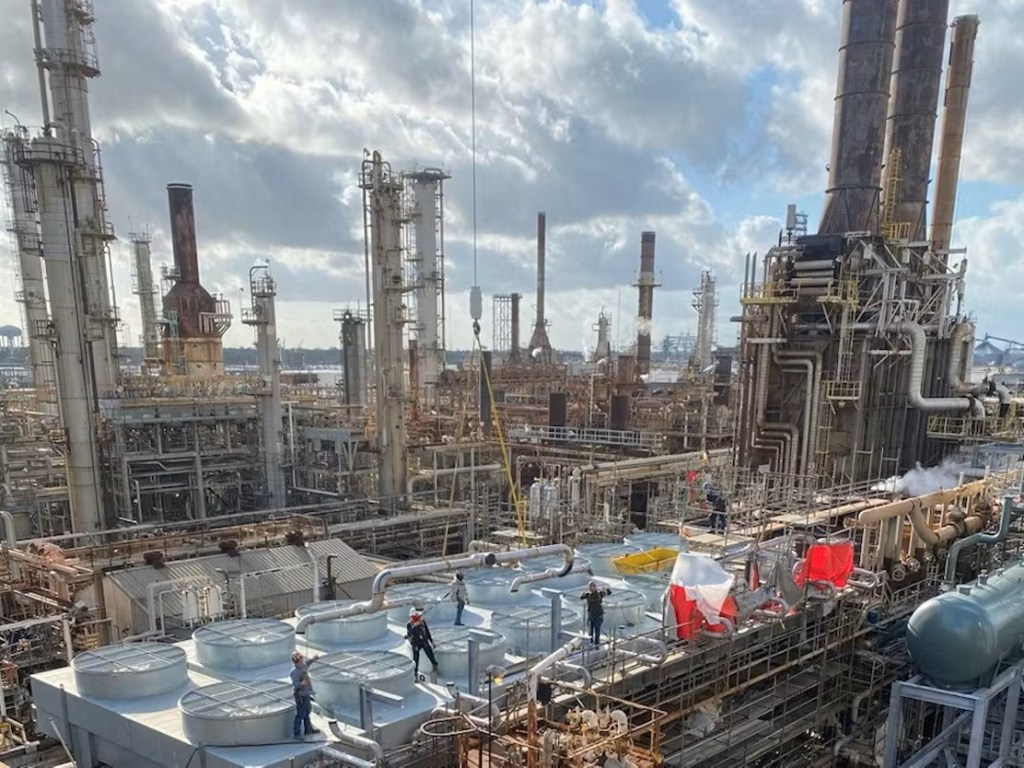
According to the Oil & Gas Journal, PBF (owner of Torrance Refinery and another HF unit near New Orleans) is collaborating with Honeywell Spending $650 million plus updating a refinery in Louisiana that also has an alkylation unit using HF. 

It looks like they don’t have any problem spending money (twice the estimated costs of converting an alkylation unit from HF) and looks like they have no problem using technologies by Honeywell UPO (The manufacturer of the leading alternative to HF). 

So the arguments that there are no alternatives or that they are “prohibitively expensive” Seem not to hold water. 

County Reports on HF Initiative

In December of 2022, Los Angeles County completed a report to the Board of Supervisors about the conversion from HF at our local refineries. We just received the report and want to share it.

It’s a great “report” that confirms much of what TRAA has been suggesting about the danger posed by an accidental release of a significant quantity of MHF, the fact that there have been a large number of releases in the very recent past (20 cited in the report), and the reality that any of these 20 could have resulted in a catastrophic release.

However, it repeats a completely discredited estimate of costs in the billions of dollars (they say that the cost would be greater than the net worth of the facilities themselves. See bottom of Attachment III). SCAQMD, US EPA and TRAA has assembled plenty of data showing that the cost of conversion is well within normal investment range for companies making between $3 and $11 billion annually. Valero themselves have built from the ground up an alkylation unit using an alternative for around $400 million. Conversion would likely be significantly lower according to the vendors of those technologies.

Here is the report:

Farewell Sophie Dreifuss

We are sorry to report that Sophie, Dr Genghum Eng’s wife and active fighter against HF passed away last month. We’ve lost a member of the TRAA family

She came to many meetings and events, really understood the issue, was always ready to help, was obviously a big support to Eng in their numerous efforts to save the environment and community health.

Sophie was clearly very smart and had a great smile. She will is greatly missed among those who seek to make the world better.

Together they made many contributions to the campaign to get rid of MHF/HF.

Here is her obituary from the Daily Breeze:

U.S. EPA orders Valero to improve chemical safety at California refinery

According to Reuters (Link to article):

Crude oil refiner Valero Energy Corp (VLO.N) agreed to pay a $1.2 million fine over violations of chemical safety regulations at a California refinery, the U.S. Environmental Protection Agency said on Thursday.

The company will also make changes to improve process safety at the refinery, the EPA said in a statement.

After chemical incidents at the Benicia Refinery in 2017 and 2019, a 2019 EPA inspection at the facility identified several areas of noncompliance, including that Valero failed to immediately report releases of hazardous substances and update certain process safety information, the EPA said.

If Valero violated this many safety regulations at Benicia, is there any reason to think it is better in Wilmington? Especially with the huge quantity of the deadly HF stored there?

Perhaps we should encourage the EPA to look closely at our local Valero Refinery.

City of Torrance Local Hazards Plan

The City of Torrance is updating their Local Hazard Mitigation Plan (LHMP) , and is asking for input. They are providing a survey to understand our concerns and preparedness. This is an opportunity to let the city, and the new Emergency Services Coordinator, know of our concerns about HF and the refinery.

TRAA’s view (www.TRAA.website)  is that the refinery, the workers at the refinery, and the City are doing or will do everything they can to make the use of HF/MHF safe. However, we know HF is an exceptionally dangerous chemical in that it can cause Mass casualties and refineries are vulnerable to accidents, natural disasters, intentional acts of Terror (According to the AQMD 2019 Senior Staff report). So the only fully safe thing to prevent a catastrophic release is for the refinery to convert from HF/MHF to one of the multiple vastly safer alternatives.

Many South Bay cities, the County Board of Supervisors, County Health Dept., state officials and numerous Senators and Representatives have written letters to support the conversion from HF.

We urge all to follow the link below to take the survey and speak facts to wishful thinking.

From the City’s website:

The City of Torrance Office of Emergency Services is preparing an update to the Local Hazard Mitigation Plan (LHMP). The updated City of Torrance LHMP will replace the 2017-2022 LHMP by assessing and identifying both natural and human-caused hazards local to Torrance that may impact the City. The 2023 LHMP will summarize vulnerabilities of the community and assess ways in which the City can reduce the impacts of these threats through long-term, hazard mitigation projects.

This plan will help create a safer and prepared community for residents, businesses, and visitors to the City of Torrance. The LHMP allows public safety personnel, city staff, elected officials, and members of the public to understand the threats from natural and human-caused hazards in our community.

The LHMP is updated every five years (reviewed annually) to ensure we have the most recent community information, hazard data, and new mitigation project ideas.

How Can I Get Involved?

  • Anyone who lives or works in Torrance, or is interested in the future of the community, is invited to participate in the plan update. Those interested may attend Local Public Emergency Committee meetings, completion of the LHMP survey, and review the plan to offer comments.
  • Take our Online LHMP Survey(ends April 20, 2023), which asks for information about past experiences with natural hazards and how our LHMP can be most useful. Your responses will ensure that you and the rest of our community can get the help and resources that are needed during unforeseen events.

Take our survey NOW, let your voice be heard! Encourage your friends, family, and neighbors to do the same.