A list of “In The News” posts appear in the right-hand column of every webpage. Be instantly alerted via email when a new item is posted on “In The News” by entering your email address in the Follow “In The News” box that appears on every webpage. Subscribe to the TRAA Newsletter to stay up-to-date.
March 24, 2026, 12:39 AM PDT / Source: The Associated Press via NBC News
A large explosion at an oil refinery near the Texas coast on Monday shot plumes of smoke into the air and forced nearby residents to shelter in place, officials said.
No one was injured in the explosion at the Valero refinery in Port Arthur, about 90 miles (145 kilometers) east of Houston, Mayor Charlotte M. Moses said. She urged residents in parts of the west side of the city to stay put, saying firefighters had arrived.
This is yet another explosion at a refinery which uses massive amounts of HF, the 4th in less than 12 years. If you want to help prevent another disaster, follow the NRDC Lawsuit status to remove the HF threat.
From the Daily Breeze today: The FBI warned some law enforcement agencies in California recently that Iran could launch drones at the West Coast from an offshore boat as a retaliatory attack, according to reporting by ABC News
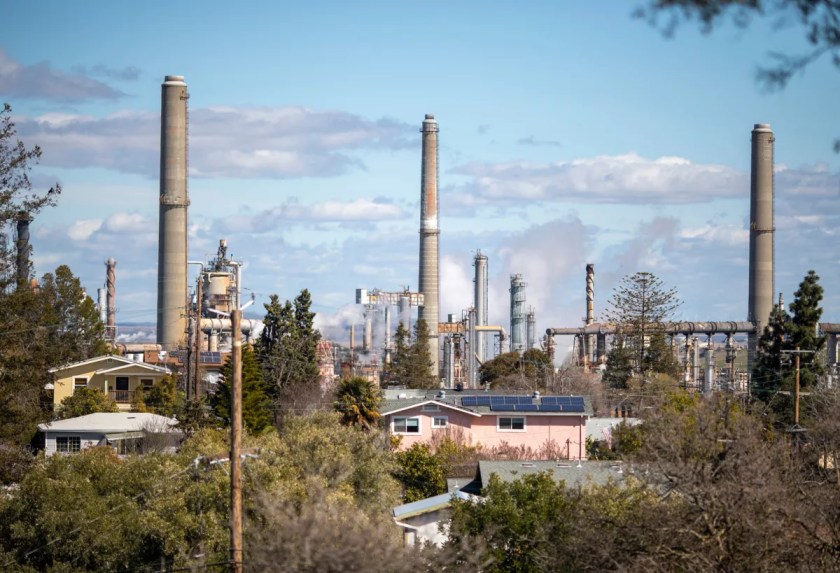
The Torrance Refinery could be a primary target for such an attack, as it could kill or injure thousands, as well as disrupt operations at both LAX and the local ports.
If such a thing were to occur, an attack at either the Torrance Refinery or that Vallero Refinery could release massive amounts of deadly HF which could kill or injure thousands. That is yet another reason that we must get rid of HF in the local refineries.
As she announced at the recent TRAA Rally, Congresswoman Maxine Waters introduced the “Preventing Mass Casualties from Release of Hydrofluoric Acid at Refineries Act of 2026” (H. R. 7384), with 7 cosponsors including Ted Lieu and Nanette Barragan.
Rep. Waters, whose district includes the Torrance Refinery, has been a long-time supporter of TRAA, and has long fought to make the refinery safer for workers and the community alike.
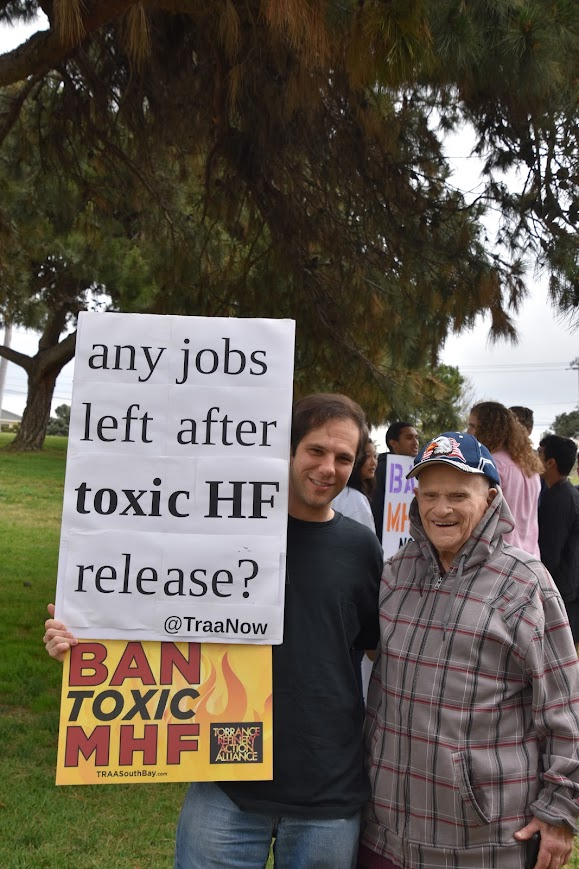
The Fund would award be given annually to a TRAA person who exemplifies the “passion, inspiration, kindness, humor, and determination to make the world a better place that was embodied by David Poster.” To be announced at the anniversary event or some similar public activity. (the would include a gift certificate for Handel’s Ice Cream! – David’s favorite and why he lived to be nearly 99!)
TRAA thanks the Poster Family for your very generous contribution, and fondly remembers David and his work over the years.
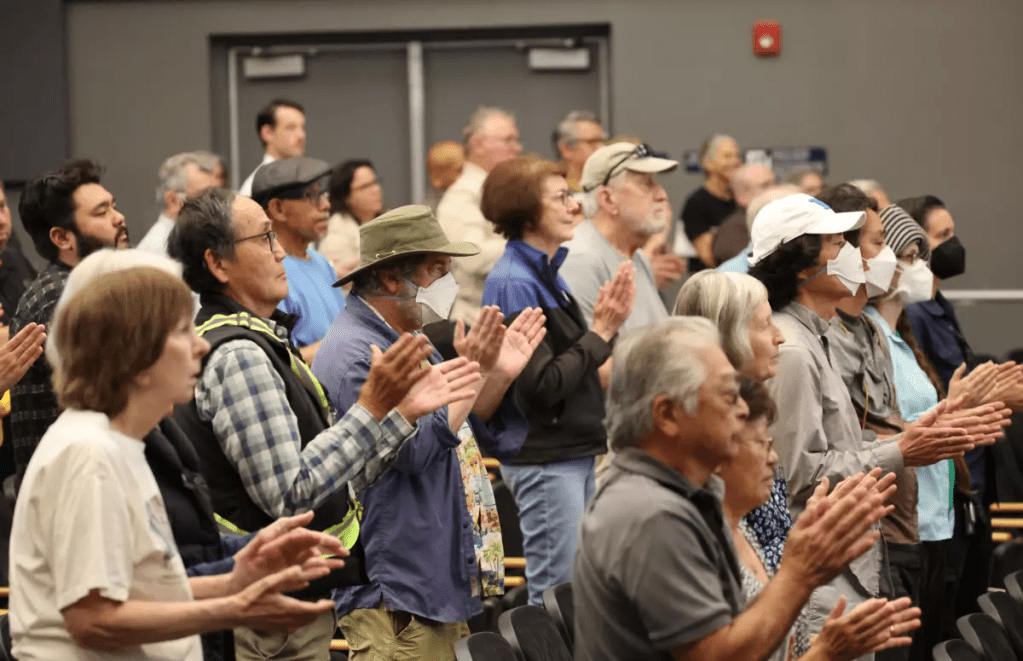
An excellent report from By Jasmine Mendez, LA Times staff writer, about our Teach-in and Rally last Saturday.
From the Los Angeles Times: Residents and advocates gathered Saturday to demand the ban of a chemical that’s used at a Torrance oil refinery and that they say has the potential to cause a mass casualty disaster.
The rally included a talk by County Supervisor Janice Hahn, a long-time supporter, a video from Congressperson Maxine Waters (who announced she is introducing a bill to ban HF/MHF from refineries nationwide), and an announcement of a new David Poster ACTION Memorial Fund to be given annually to a TRAA person who exemplifies the “passion, inspiration, kindness, humor, and determination to make the world a better place that was embodied by David Poster.”
In a reversal, the agency plans to calculate only the cost to industry when setting pollution limits, and not the monetary value of saving human lives, documents show. This means that human lives mean nothing in the Cost/Benefit Analysis.
From the NY Times on Jan 12, 2026. For decades, the Environmental Protection Agency has calculated the health benefits of reducing air pollution, using the cost estimates of avoided asthma attacks and premature deaths to justify clean-air rules.
Not anymore.
It’s a seismic shift that runs counter to the E.P.A.’s mission statement, which says the agency’s core responsibility is to protect human health and the environment, environmental law experts said.
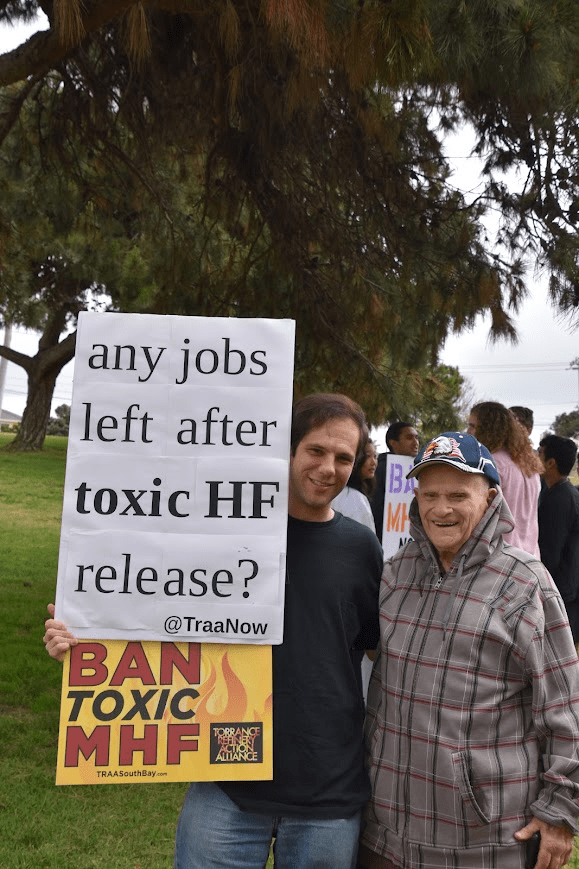
TRAA Mourns the passing of our beloved David Poster.
It is a sad day for TRAA as we heard the news of the passing of our beloved friend and longtime member David Poster. He died peacefully at home in the morning of January 2nd in his sleep and surrounded by love. It was what he wanted. The UCLA Body Donation program picked up his body. As the guy was wheeling him out of the house, he said to his family, “Your dad is a hero.”
David was an active member of TRAA until the end, attending most of our meetings and events. Indeed, we planned a 99th birthday celebration at our February event to recognize the refinery explosion.
Instead of flowers, please make donations in his name to any of the following organizations, the ACLU of Southern California, the Hydrocephalus Foundation or the Torrance Refinery Action Alliance.
The exact cost for Big West Oil’s conversion of its HF alkylation unit to Honeywell UOP’s ISOALKY technology at its North Salt Lake refinery has not been widely disclosed in public announcements by the companies involved.
However, a report referencing a 2017 article in the Oil & Gas Journal indicated that the retrofit for a similar project at the nearby Chevron Salt Lake City refinery (the first complete conversion) had an estimated cost of about $67 – $87 million.
Big West Oil announced in November 2021 that it had selected the ISOALKY technology for the revamp of its existing HF unit. Project costs for conversions of this nature can vary based on the specific refinery’s size, scope of work, and capacity.
How much for the conversion at Wynnewood from HF to KSAAT?
The publicly estimated cost for the conversion of the Hydrofluoric (HF) acid alkylation unit to KBR’s Solid Acid Alkylation Technology (K-SAAT) at CVR Energy’s Wynnewood refinery has been cited in company updates and regulatory filings.
CVR Energy originally estimated the overall capital investment for the HF mitigation and yield-enhancement project at Wynnewood to be about $90 million.
More recently, a CVR Energy executive stated that the company now expects the total cost of the project to be $135 million to $140 million.
This project involves replacing the existing HF Reactor/Settler section with the K-SAAT solid acid technology, which is intended to increase alkylate yield and eliminate the use of liquid hydrofluoric acid for safety and environmental benefits.
These actual costs are a tiny fraction of the claims made by the local refineries, and demonstrate their lack of objectivity about the matter. Why should we believe them?
Please view and learn from this documentary about the Torrance Refinery explosion of 2015, and the local efforts to remove the dire threat posed by the continued use of Hydrogen Fluoride (HF) at our South Bay refineries.
Produced by Olivia Rosenbloom in 2019 and newly released, “Near Miss” shows the work at both the City of Torrance and the AQMD to require the refineries to convert to a practical and safer alternative in their processes. Watch it HERE.
Jesse Marquez, founder and executive director of the Coalition for a Safe Environment, died on Nov. 3 after being in a coma following a Jan 13th accident where he was hit by a car in a crosswalk.
Jesse was a friend and supporter of TRAA and very active in local politics, especially regarding refineries and the ports. Read more in this Random Lengths article and from the Los Angeles Times.




 Torrance Refinery Action Alliance