Congresswoman Nanette Barragán Welcomes EPA Administrator Michael Regan to Los Angeles to Highlight Environmental Justice Issues

On Thursday, August 19, U.S. Environmental Protection Agency Administrator Michael Regan joined Congresswoman Nanette Diaz Barragán and local activists to discuss environmental justice issues in Los Angeles County.

Congresswoman Barragán led EPA’s top person, Administrator Michael Regan, on a tour of her district to show him some of the neighborhoods severely affected by pollution, and facilitate discussions between Administrator Regan and Los Angeles County residents who live near these polluted sites.
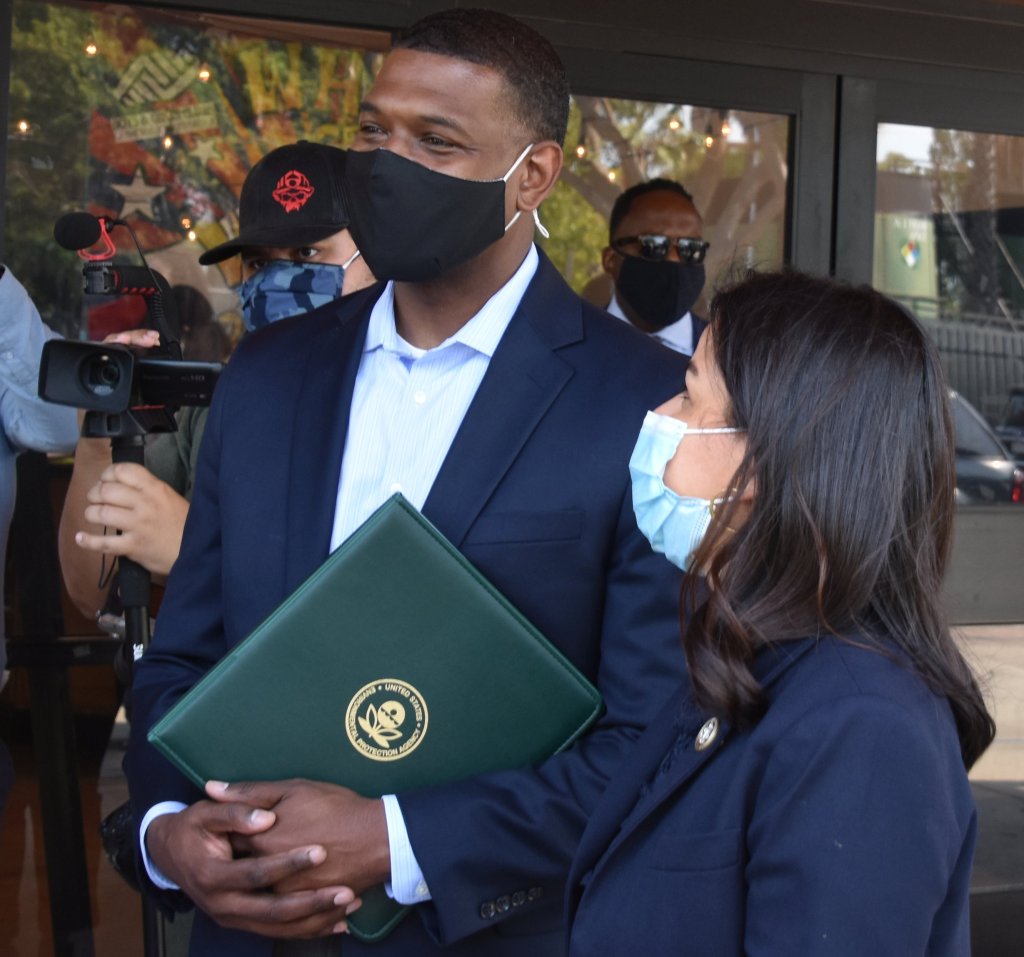
Congresswoman Nanette Barragán and EPA Administrator Michael Regan

The Congresswoman’s 44th District comprises Carson, Compton, East Compton, East Rancho Dominguez, Lynwood, North Long Beach, San Pedro, South Gate, Watts, Walnut Park, West Rancho Dominguez, Willowbrook, and Wilmington. The district is the setting for the New York Times opinion video Living Near Oil Production Is Deadly. Why Don’t California Lawmakers Care? by Josiah Edwards, who is a climate organizer in Carson.

At the Wilmington Boys & Girls Club, Congresswoman Barragán and Administrator Regan heard from local advocates, made brief remarks, took questions from journalists, and listened to local environmental justice advocates. They looked at oil drilling sites right next to homes and the Boys & Girls Club and went on a short drive to the site of a working oil pump immediately between two homes and right in the middle of a residential neighborhood.

Congresswoman Nanette Barragán is a strong advocate for removing highly dangerous hydrogen fluoride from the two South Bay refineries that use it. She and Congressman Ted Lieu wrote a letter to the AQMD expressing their support of a ban, see:
https://traa.website/letters-of-support-from-elected-officials/

Congresswoman Barragan requested materials from TRAA for her to personally deliver to Administrator Regan.

Congresswoman Nanette Barragán
Continue reading “Congresswoman Nanette Barragán Welcomes EPA Administrator Michael Regan to Los Angeles to Highlight Environmental Justice Issues”

National Expert on Terrorism and Hazardous Chemicals to Headline TRAA’s Monthly Zoom Meeting on Wednesday, August 11 at 7:00 p.m. Pacific Time

Washington D.C.-based public interest consultant Rick Hind has been a leading advocate for environmental justice for decades. In his twenty-six-year career as the former Legislative Director of Greenpeace, Hind led a national campaign to prevent catastrophic chemical accidents, which resulted in a presidential executive order and revised EPA regulations in 2017, successfully aided in winning passage in the U.S. House of Representatives of the first true disaster prevention legislation in 2009, and led U.S. efforts to the U.N. Stockholm treaty to gradually eliminate some of the worst toxic pollutants on a global scale.

Rick Hind is one of the nation’s foremost experts on a variety of toxics issues, including security issues related to chemical hazards and the chemical industry. In the 2004 New York Times Op Ed Lots of Chemicals, Little Reaction, Rick Hind, along with co-author David Halprin, brought to the public’s attention “one of the most urgent threats to our safety: the risk that terrorists could cause thousands, even millions, of deaths by sabotaging one of the 15,000 industrial chemical plants across the United States.”

Rick Hind

In his 2013 U.S. House of Representatives testimony, Homeland Security Regulations Leave Millions of People at Risk, Rick Hind emphasizes the threat that the American public faces from potential acts of chemical terrorism.

Rick Hind has graciously accepted an invitation to open TRAA’s August monthly Zoom meeting with his views on transitioning HF refineries to using a vastly safer alternative. Following his comments, Rick will be available to answer questions.

To attend the virtual meeting, RSVP with an e-mail request for a Zoom link to TRAA President Steven Goldsmith at info@TRAA.website. If you have a question for Rick Hind, include it in your request for a Zoom link. You’ll be able to ask a question during the meeting as well .

TRAA Seeking Letters of Support & Comments to EPA by July 31 Deadline

As part of the national effort to phase out HF in refineries, TRAA has submitted a proposed amendment to the EPA Risk Management Plan (RMP) Rule CFR 40 Part 68. The objective of TRAA’s amendment is to force conversion from HF to a vastly safer alternative.

On January 20, 2021, President Biden issued E.O. 13990, which directed federal agencies to review existing regulations and take action to address priorities established by the Biden administration. The EPA responded by undertaking a revision to its Risk Management Plan regulations (40 CFR part 68 – Chemical Accident Prevention Provisions) to minimize public impacts of accidental releases of highly hazardous chemicals.

We’re asking your help in submitting a comment and letter to the EPA in support of TRAA’s proposed amendment. These will be read by EPA staff as they write a revised Rule — due out in September 2021. Submitting your or your organization’s thoughts and any additional data or information will be invaluable in the effort to protect communities from a catastrophic release of HF.

Continue reading “TRAA Seeking Letters of Support & Comments to EPA by July 31 Deadline”

Congresswoman Maxine Waters to Headline TRAA’s Monthly Zoom Meeting on Wednesday, July 14 at 7:00 p.m. Pacific Time

Considered one of the most powerful women in American politics today, Congresswoman Maxine Waters is a strong and impassioned advocate for eliminating the massive quantities of highly dangerous hydrogen fluoride (HF) from the two refineries in the South Bay that use it.

Congresswoman Maxine Waters is among the leaders in the effort to ban HF since day one. Her constituents in the 43rd Congressional District, which includes portions of the cities of Los Angeles (including LAX) and Torrance, and the entirety of the cities of Hawthorne, Lawndale, Gardena, Inglewood, and Lomita, are at high risk from major accidental release of HF from either the Torrance Refining Company, which is in her District, or the Valero Refinery in Wilmington.

Congresswoman Maxine Waters

Congresswoman Maxine Waters has graciously accepted an invitation to open TRAA’s July monthly zoom meeting with her views on banning HF. Following her comments, she will be available to answer questions.

To attend the virtual meeting, RSVP with an e-mail request for a Zoom link to TRAA President Steven Goldsmith at info@TRAA.website. If you have a question for Congresswoman Waters, include it in your request for a Zoom link. You’ll be able to ask a question during the meeting as well.

Urgent: Also contact TRAA President Steven Goldsmith if you’d like to join TRAA’s team to propose an EPA Rule banning HF. An important deadline for submitting data is coming up this Thursday, July 15, 2021. This is a chance to help with TRAA’s submittal to the EPA. Hear more information at the July 14 TRAA meeting. 

Read Congresswoman Maxine Waters’ letter to the  AQMD supporting a ban on HF at the South Bay refineries by clicking here, and learn more about her by clicking here.

Toxic Clouds on the Horizon; The HF Threat Continues

On May 4, 2021, another refinery suffered a leakage of highly toxic hydrogen fluoride (HF). This time it was the Marathon Petroleum Corporation’s Galveston Bay Refinery in Texas City, Texas, 41 miles south of Houston.

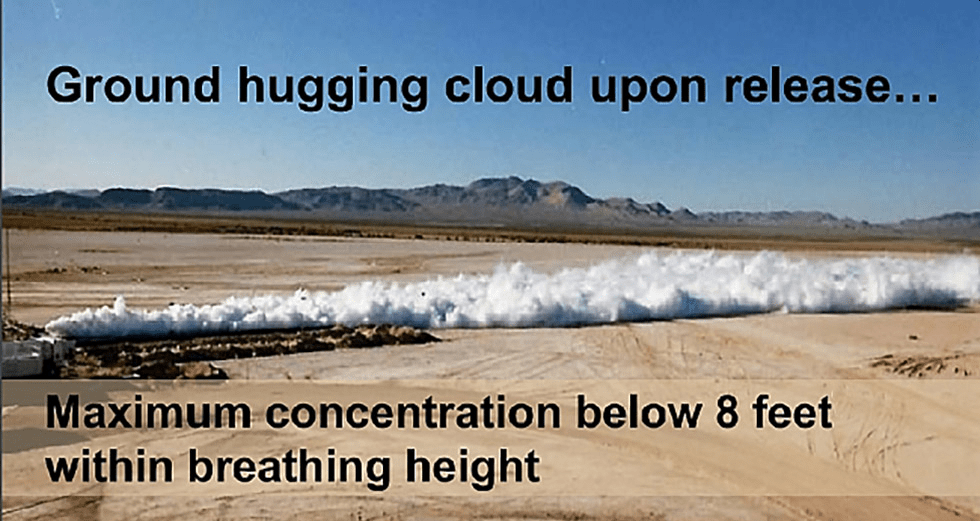
HF Release Test in the Nevada Desert

by Environmental Journalist Isabelle Jeng

If you think a leak at a refinery in Texas doesn’t concern you, think again. If you live, go to school or work in southern Los Angeles County, you are among the millions at risk of serious injury from hydrofluoric acid (HF), which is used to make high-octane gasoline. If you’re within six miles of the Torrance refinery or the Valero refinery in Wilmington, you are among the tens of thousands who risk death from a large release of this chemical. . . .

Click to read Isabelle Jeng‘s full article in “Foggy View News” of the Palos Verdes – South Bay Sierra Club website.

Safer and More Efficient Alkylation Process Now at Commercial Scale

CHEVRON and Honeywell have started commercial operation of a new alkylation process at Chevron’s Salt Lake City refinery using an ionic liquid catalyst that is vastly safer and more efficient than the HF alkylation process it replaces

Chevron’s Salt Lake City refinery is world’s first commercial-scale process unit using ISOALKY technology to produce ionic liquid-based alkylate for higher octane motor fuels. (Photo from The Chemical Engineer)

Article by Amanda Doyle in The Chemical Engineer

Alkylation combines light olefins such as butylene with isobutane to create a high-octane blending component that can be used to produce high-octane gasoline. . . . The ISOALKY process was proven in the US at a demonstration unit at Chevron’s Salt Lake City refinery for five years. Work began on converting Chevron’s hydrofluoric acid (HF) alkylation unit in Salt Lake City to ISOALKY technology in 2017. The commercial-scale unit has now become operational. . . .

Click to read Amanda Doyle’s full article in The Chemical Engineer.

Read about Chevron & Honeywell’s ISOALKY Process and watch an informative video by clicking here.

Gov. Whitman, Retired Generals Call on EPA to Protect Against Chemical Plant Disasters

Today, former EPA administrator and New Jersey governor Christine Todd Whitman, retired generals Russel Honoré and Randy Manner, former EPA official Robert Bostock, and David Halperin, submitted a comment to the Environmental Protection Agency urging it to strengthen rules to make U.S. chemical plants less vulnerable to potentially catastrophic explosions and toxic releases.

The authors begin: “We believe the requirements of U.S. national security make it urgent that EPA move to issue new, strong Risk Management Plan (RMP) rules that adequately protect the American people against chemical plant explosions. Millions of Americans, particularly low-income people and people of color, live near hazardous chemical facilities. Accidents, storms that have been intensified by climate change, and deliberate attacks, including terrorism and cyber attacks, all pose risks of chemical explosions that could cause widespread destruction and death. 

Christine Todd Whitman
Former EPA administrator and New Jersey governor Christine Todd Whitman
“EPA should restore and build on its 2017 rule, including by:
  • requiring all RMP facilities to assess safer alternatives to existing chemical processes;
     
  • requiring all these facilities to share their safer technology analyses with communities and emergency responders; and,
     
  • starting with the highest risk facilities, requiring chemical facilities to substitute safer alternatives to their processes, wherever feasible, that will eliminate or significantly reduce the consequences of a catastrophic release.”

Continue Reading >

Meet the TRAA Voter Advisory Panel

The TRAA Voter Advisory Panel has been newly formed to provide voters with information on candidates whose views most closely align  with TRAA’s that HF refineries need to transition to a vastly safer alkylation catalyst. Their voter recommendations will be posted on this website’s In The News blog

Continue reading “Meet the TRAA Voter Advisory Panel”

Free TRAA “Ban Toxic MHF” Lawn Sign

Show your support for TRAA’s efforts to making the South Bay and the nation a safer place to live.

Please provide your name and address where the sign will be delivered. One of our friendly volunteers will write back to verify your information and then bring the sign to you.

← Back

Thank you for your response. ✨

In The News

A list of “In The News” posts appear in the right-hand column of every webpage. Be instantly alerted via email when a new item is posted on “In The News” by entering your email address in the Follow “In The News” box that appears on every webpage. Subscribe to the TRAA Newsletter to stay up-to-date.

Continue reading “In The News”